
The Politics of the Dropdown
How a Country-Code List Inherits a Century of Disputed Borders
The country lists, flags, and maps built into software look like neutral infrastructure. They are the frozen output of political decisions about who counts as a country, and the defaults were set by institutions long before any form field rendered them.
A message came through the contact form of blogroll.blog, a directory of blogs I run. The person who wrote in was polite, and worked, they explained, under the laws of mainland China, which was why they would not be linking to it. The problem was a flag. Blogroll lists blogs from around the world and marks each with the flag of a country, and for one Taiwanese blog it had shown the flag of Taiwan and named the place Taiwan. Nobody was obliged to link either way, and blogroll asks for nothing in return. This was the writer telling me, as a courtesy, why their own legal framework kept them from pointing a link at a page that named Taiwan the way it did.
The reply I gave was true and also incomplete. The directory does not choose flags. It reads a country field, matches it against a standard list, and renders whatever the list returns, the same way for a blog in Osaka as for one in Tallinn. There is no editor deciding that Taiwan is a country and Tibet is not. There is a table, applied without exception, and the consistency of the table is the whole of its fairness. I called it consistency rather than a position, and moved on. The trouble is that the table itself holds a position. It was just decided by someone else, a long time ago, and handed down until it looked like plumbing.
The list most software reaches for is ISO 3166, the international standard for country codes. It is the reason a form knows that Canada is CA and Japan is JP, and it is maintained by a body that is careful to say it does not decide who is a country. It follows the United Nations, drawing its names from the terminology the UN keeps for official use. So the standard points at the UN, and the UN points at its own history, and the history, in the case that started this, points at a single afternoon in 1971. Resolution 2758 restored the China seat to the government in Beijing and removed the government in Taipei. The text names no territory. It settles who sits in a chair. Beijing has spent five decades reading it as settling far more than that, and much of the world has spent the same five decades disagreeing, and the country dropdown inherited the argument without ever being told there was one.
What the dropdown returns for Taiwan is a compromise visible in its own wording. The code is TW, the numeric code 158, and the name in the standard is Taiwan, Province of China. A functioning state of roughly twenty-three million people, with its own currency, passport, and elections, is filed under a name that describes it as a province of the government that does not administer it. The label is not an error. It is the UN’s terminology rendered faithfully, which is exactly the point. Faithful rendering of a contested name produces a contested label, and the software passes it along without a flicker, because software cannot tell the difference between a neutral fact and a frozen argument.
Those names shift on request, and each shift is a small politics of its own. Turkey became Türkiye in the standard in 2022, Swaziland became Eswatini, Ivory Coast has insisted on Côte d’Ivoire since 1985, and a country choosing what the world must call it is a subject worth its own essay.
Recognition is where the gap between counting and existing opens widest. The number of UN member states that recognise a given entity has little to do with whether that entity behaves like a country, and everything to do with the politics around it. Palestine is recognised by roughly a hundred and forty-six members. Kosovo by around a hundred. The Sahrawi republic in Western Sahara by some forty-six. Taiwan, larger and more prosperous than most of them, by twelve. Abkhazia and South Ossetia by a handful. Somaliland, which has held elections and printed its own money since 1991, by none at all. These figures move as governments shift alliances, and the direction is not always up. Recognition is granted and withdrawn as a political act, one capital at a time.
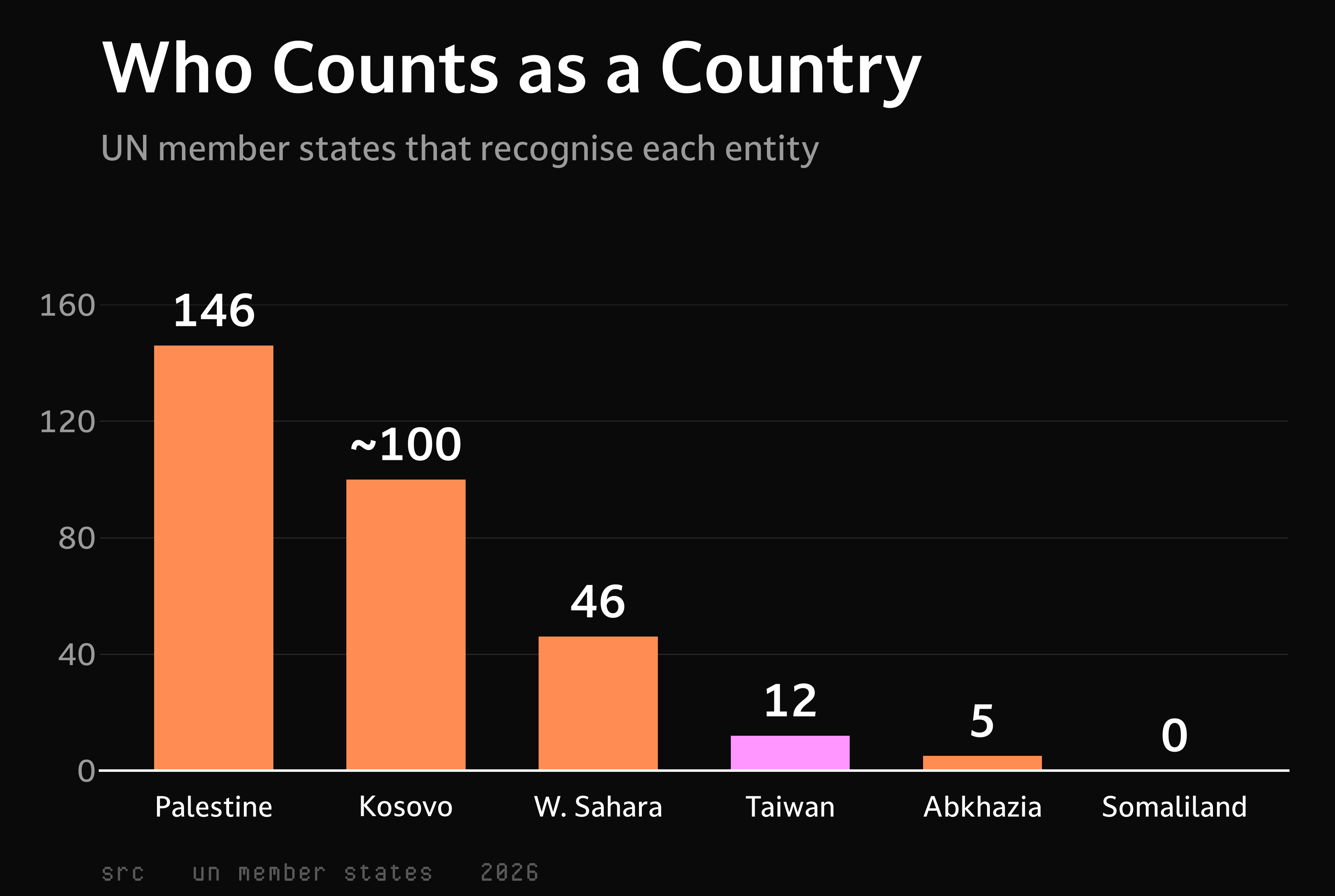
Data
| Entity | Recognising states |
|---|---|
| Palestine | 146 |
| Kosovo | ~100 |
| Western Sahara | 46 |
| Taiwan | 12 |
| Abkhazia | 5 |
| Somaliland | 0 |
The coding standard sorts the same entities into a quieter hierarchy, one measured not in recognition but in the kind of identifier a place is allowed to hold. A few contested territories get their own official codes, Taiwan among them, along with Palestine and Western Sahara. Hong Kong and Macau get codes marking them as special administrative regions, sovereignty attached elsewhere. Kosovo, which the standard has never formally admitted, is handled through a user-assigned code, XK, a slot the standard reserves for private use that the whole industry adopted because it needed something to write in the box. And a long tail of places gets nothing. Somaliland, Northern Cyprus, Abkhazia, South Ossetia, Transnistria, and the others fold into the code of the state that claims them, or vanish. Nagorno-Karabakh had a life in these lists until the territory dissolved on the first day of 2024, at which point it left them. To be uncoded is not to be nonexistent. It is to be unwritable in the places where software asks a computer to name where you are.
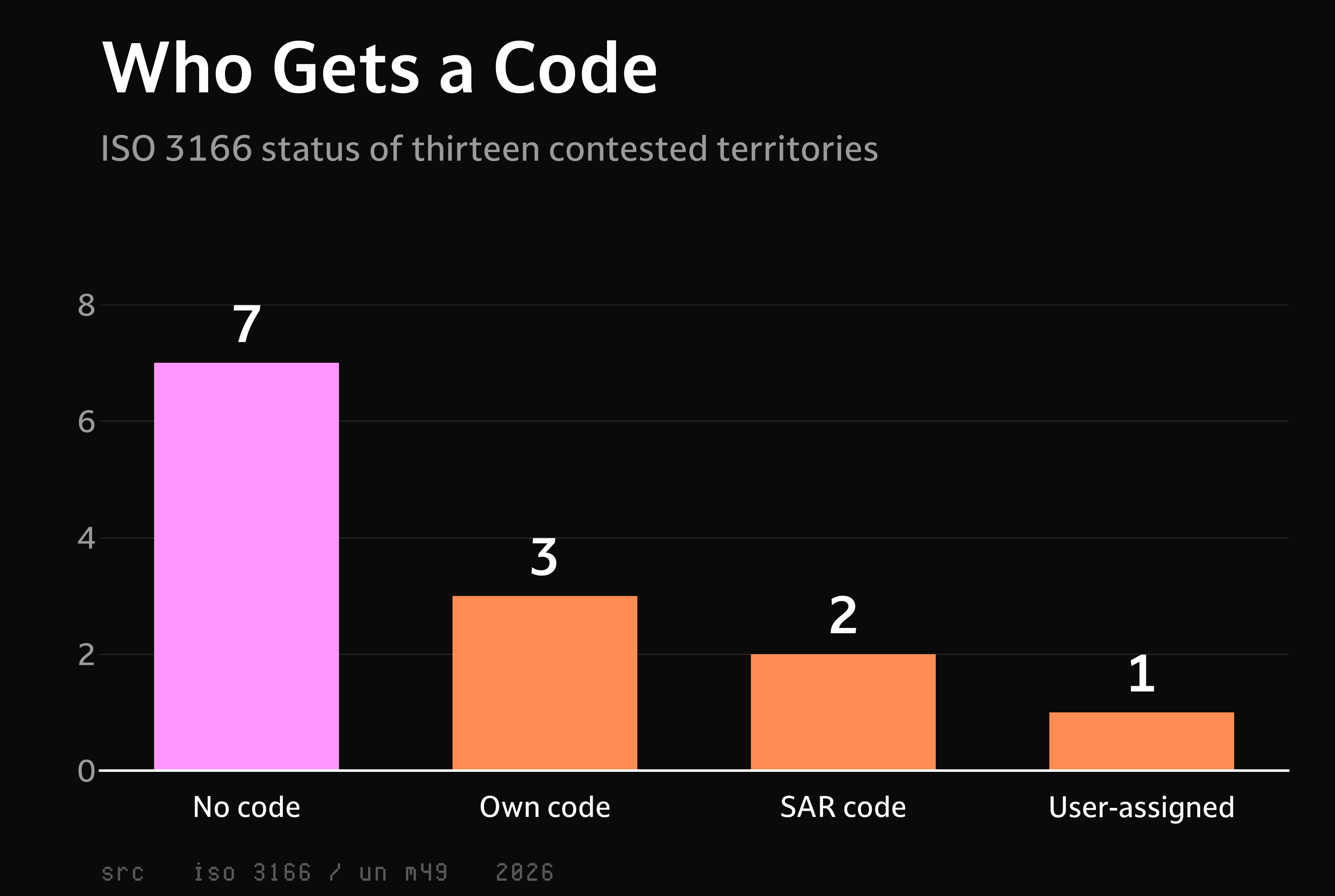
Data
| ISO 3166 status | Territories |
|---|---|
| No code | 7 |
| Own code | 3 |
| SAR code | 2 |
| User-assigned | 1 |
The flag that started the complaint is the same decision wearing a picture. On phones and in messaging apps, flag emoji are not really images at all. Each one is a pair of letters drawn as a flag, built from the two-letter ISO 3166 codes turned into what Unicode calls regional indicator symbols. Type the code for a country and the system paints its flag. The corollary is unforgiving. A place with no code has no flag emoji, because there is no pair of letters to draw. Somaliland cannot be flown in a text message for the same reason it cannot be selected in a form. The absence in the table becomes an absence on the keyboard. And where a flag does exist, it can be selectively removed. For several years, phones set to the China region hid the Taiwan flag emoji specifically, so the same character that appeared normally elsewhere resolved to nothing for those users. The letters were in the standard. The picture was withheld. Whether that particular suppression still holds on a given device and software version is the kind of detail that changes without notice, which is itself the lesson. Even the rendering of a fixed code is a setting somebody controls.
Maps are where the neutrality dissolves in plain sight, because there has never been one map. The large mapping services draw solid lines around the borders treated as settled and dashed lines around the ones in dispute, and they say openly that no single authority resolves them all. What they show depends on where the viewer is standing. Seen from inside India, Kashmir and Arunachal Pradesh appear as undisputed Indian territory, and seen from most other places they carry the dashed lines of a claim. The body of water between Iran and the Arabian Peninsula is the Persian Gulf on most of the globe and the Arabian Gulf to users in the Gulf states. The sea between Korea and Japan answers to two names depending on the account asking. Product decisions of this kind are documented across the industry and specific to time, product, and locale, which means any single example dates quickly. The durable fact is the structure. The map localises itself to the politics of the person reading it, and calls the result the map.
Set against all this variance, one country’s positions make a useful test of whether recognition follows any clean principle, and Canada serves as well as any, because its record is public and mixed. Canada holds to a One-China policy, recognising the government in Beijing and keeping only unofficial ties with Taipei, which places it on the Beijing side of the very question behind the complaint. It recognised Kosovo’s unilateral declaration of independence in 2008. It rejects Russia’s annexation of Crimea and does not accept the changed border. It recognised the State of Palestine in September 2025, having abstained a year earlier on the question of Palestinian UN membership. And in the spring of 2026 it called Morocco’s autonomy plan for Western Sahara a serious and credible basis for settlement, warm language that stops carefully short of recognising Moroccan sovereignty over the territory. Read together, these are not applications of a rule. They are decisions, each shaped by alliances, timing, and the cost of the moment. Canada endorsed one unilateral secession and refuses others, rejects borders changed by force while blessing borders changed by declaration. The point is not that this is hypocrisy. The point is that there is no formula underneath, only a sequence of choices, and the dropdown flattens the sequence into a list that looks like law.
There is a further category the list cannot reach, the places with no code, no recognition, and no dashed line anywhere. Tibet, West Papua, Chechnya, Catalonia, the Kurds, a people of tens of millions with a self-governing region in northern Iraq and a sovereign state nowhere. Some are absorbed so completely into a recognised country that they never surface as a distinct entity in any table software consults. To be standardised out of existence is the quietest fate of all, more final than a contested label, because a contested label at least records that there was something to contest. The stateless do not get a row.
None of this is an argument for a different table, and I have not changed the one on blogroll. Any list a piece of software could use would carry the same freight, because the freight is not in the choice of standard but in the fact that naming the world requires deciding what the world is made of, and that decision cannot be neutral no matter who makes it. What is worth resisting is only the illusion that hangs over the whole apparatus, the sense that the country field, the flag, the map tile, and the code are infrastructure in the way a water main is infrastructure, doing a mechanical job with no view of its own. They have a view. It arrived down a long chain, from a form field to a standard to a terminology bulletin to a room in 1971, and by the time it reaches the dropdown the argument has been sanded smooth and rebranded as a default. There is no map from nowhere. There is no list from nowhere. There is only a choice old enough and quiet enough that everyone has stopped remembering it was made.
The flag on blogroll is still the one the standard returns. It will keep being that flag, drawn the same way for every blog, which remains the fairest thing the directory knows how to do and is still not the same thing as neutral. The site owner who wrote in was not wrong that the flag was a position. They were only mistaken about whose. It was never blogroll’s. The project inherited it, the way every country dropdown does, from a list that decided the shape of the world before anyone thought to ask it to.
Request an AI summary
Learn more about the ideas and references behind this note.
FAQ
- Does an ISO country code mean a place is a recognised country?
- No. ISO 3166 is a coding standard for names in official use, not a register of statehood, and it follows the United Nations rather than judging sovereignty. Taiwan carries the code TW and the name Taiwan, Province of China, is recognised by twelve UN members, and functions as a state of roughly twenty-three million people. Hong Kong and Macau carry codes and are not states at all. Somaliland has governed itself for three decades with no code and no recognition. A code tracks institutional consensus about names, not the existence of a country.
- What did United Nations Resolution 2758 actually decide about Taiwan?
- Resolution 2758, passed on 25 October 1971, restored the seat of China at the United Nations to the government in Beijing and expelled the representatives of the government in Taipei. Its text names no territory and says nothing explicit about Taiwan's sovereignty. Beijing reads it as having settled the question in its favour, while Taipei and a number of other governments argue it decided only who occupies the China seat. That contested reading is the disagreement every country dropdown quietly inherits.
- What are some related topics to explore?
- iso 3166 country codes politicstaiwan province of china namingun resolution 2758 taiwandisputed territory maps localizationcanada recognition foreign policyflag emoji regional indicators
Defined Terms
- ISO 3166-1
- The part of the ISO 3166 standard that assigns two-letter, three-letter, and numeric codes to countries and dependent territories, maintained in line with names in official United Nations use.
- Diplomatic recognition
- A formal act by which one state acknowledges another as a sovereign state or acknowledges a particular government as legitimate, distinct from mere trade or cultural contact.
Foundations
- Standard Country or Area Codes for Statistical Use (M49)
- United Nations Statistics Division
- Resolution 2758 (XXVI): Restoration of the lawful rights of the People's Republic of China
- United Nations General Assembly, 1971
Related Reading
Related Notes
- The Country That Runs on Newcomers
- In early 2025 more people died in Canada than were born, and the country grew anyway. The shortfall was filled from outside, as it now must be. A look at how Canada engineered its dependence on immigration, and why Quebec, Germany, France, Türkiye and Japan meet the same arithmetic and deny it in different ways.
- The Tell In Your Typing
- You can hide stress from a colleague, a partner, even from yourself. The keyboard has been taking notes the whole time. On the oldest witness we own and the newest surface it leaks onto.
- The Architecture of Modern Loneliness
- A 2023 US Surgeon General advisory put chronic loneliness alongside smoking fifteen cigarettes a day. The architecture that used to hold strangers together did not collapse. It was redesigned out of the floor plan.