
The Man With the Red Flag
What Slide Rules, Typing Pools, and Horses Can Tell Artists About Generative AI
Artists overwhelmingly oppose generative AI training on their work, and a growing share use the tools anyway. The pattern repeats the pocket calculator, the office computer, and the motor car. Resistance is part of how tools get absorbed, not its opposite.
Three objects were once refused by the people who would come to depend on them. The pocket calculator, which teachers were supposed to hate. The office computer, which managers would not touch. The paintbrush, which no one ever refused, and which is the reason the other two stories are worth telling.
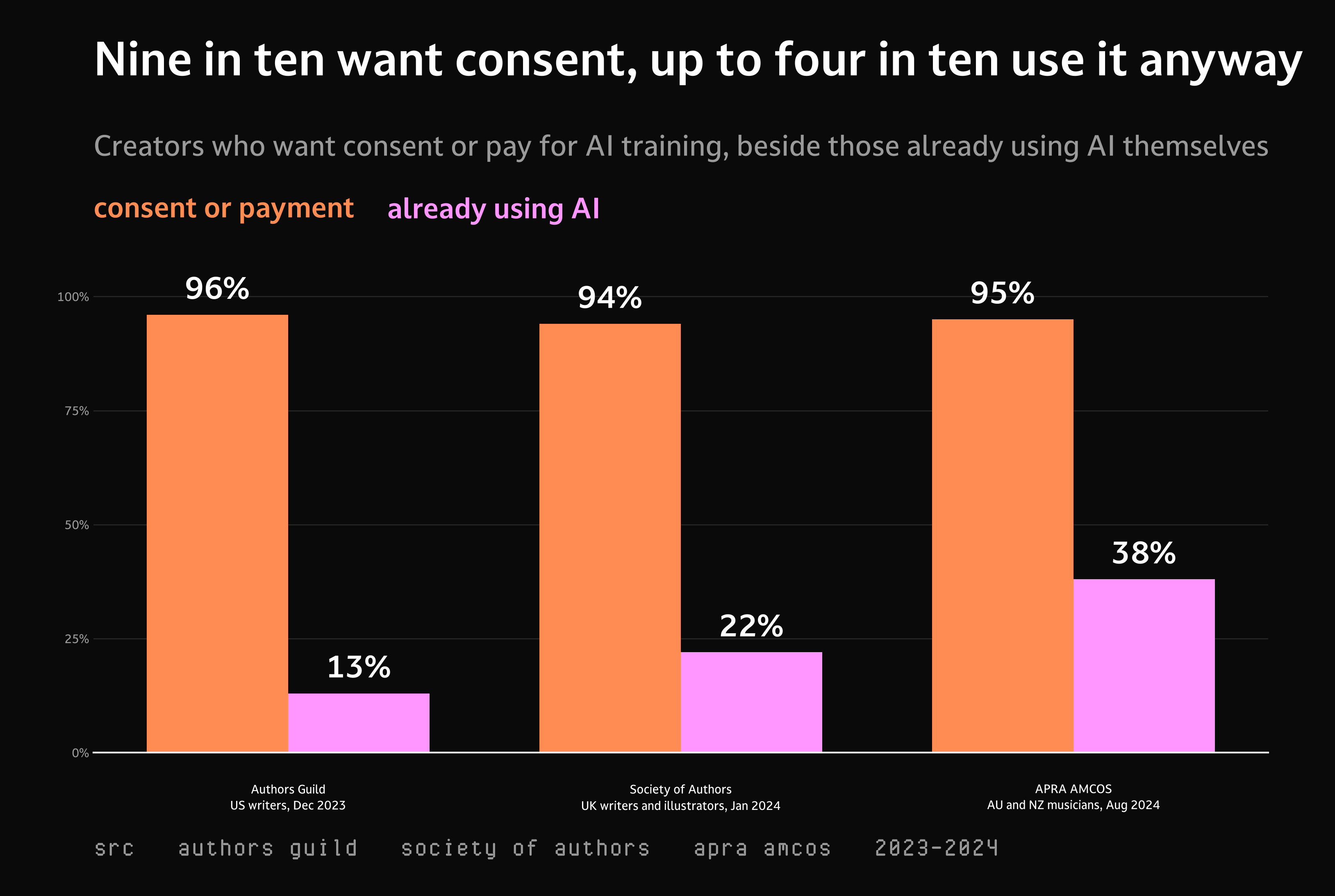
Nine in ten working writers say they want consent and payment before their books are fed to a model. Roughly the same share of musicians and illustrators say the same, survey after survey, across three countries and two years. In those same surveys, between one in eight and one in three report using generative tools in their own work. Both numbers are true at once. The refusal is about terms.
Data
| Survey | Want consent or payment | Already using AI |
|---|---|---|
| Authors Guild, US writers, Dec 2023 | 96% | 13% |
| Society of Authors, UK writers and illustrators, Jan 2024 | 94% | 22% |
| APRA AMCOS, AU and NZ musicians, Aug 2024 | 95% | 38% |
None of this makes the refusal unreasonable. The models were trained on scraped portfolios without asking, and the people whose styles were lifted noticed before anyone else did. When the ArtStation homepage filled with red “no” signs in December 2022, the platform needed three days to add an opt-out tag and a little longer to start quietly hiding the protest images. Screenwriters struck for five months in 2023 and won language saying a machine’s output is not literary material. Performers struck for 118 days and won the right to be asked before their faces are copied. Those are wins, and they are also the shape of every earlier absorption. The rules arrive after the tool, written by the people the tool frightened.
The fright is not abstract either. The loudest refusals come from people who make things by hand for a living, illustrators, session musicians, translators, and a quarter of the illustrators in one British survey had already lost a contract to a model. Most of them do not have a second career waiting. Not every talented person has a doctorate or a family house to fall back on, and for someone whose entire income is the work of their hands, a tool that does a passable version of it for free is not an interesting development. It is a threat, and the anger is earned. Where it lands is another matter. The model did not scrape anyone’s portfolio, and neither did the designer down the hall who used it to hit a deadline. The scraping was a choice a company made, and that one has a name and a courtroom. The rest has no address at all. A tool arrived that does a passable version of skilled work for almost nothing, the way the car did, and the spreadsheet did, and the moment it exists the price of that work starts falling for everyone, whether they touch the tool or refuse it. That is not the machine and it is not the person using it. It is the trade that comes with every shift in what labour is worth, and it has never once been reversed by being angry at the nearest object. The horse was not avenged by hating drivers.
Take the calculator. The story we tell is that teachers fought it and lost. The record says otherwise. A 1975 survey of mathematics teachers found two-thirds already in favour of calculators in class, and the number rose to 72 percent two years later. The teachers’ own council passed a resolution encouraging them in 1974 and, by 1980, was instructing every mathematics programme in the country to take full advantage of them at every grade. The profession most directly threatened said yes first. The resistance lived elsewhere, in parents, in editorials about children who could not add without batteries, and in the exam board, which kept calculators out of the SAT until 1994, two decades after they reached the classroom.
The people who lost were not the teachers. They were the slide rule makers. In the 1960s the largest American maker turned out about five thousand rules a month, and every engineer who built a bridge carried one. A pocket scientific calculator arrived in 1972 at $395, roughly three thousand of today’s dollars, and sold three hundred thousand units in three years to the same engineers. The company made its last slide rule on 11 July 1976 and, with some ceremony, gave it to a museum. Nobody marched.
The office took longer and was messier. A 1975 cover story promised that paper would start disappearing from desks by 1980 and be almost gone by 1990. Paper use doubled instead, peaking around the year 2000, because the first thing people did with a screen was print what was on it. By most accounts the typing pool was not the only resistance. Executives of a certain generation would not have a keyboard in the office at all, since typing was something you paid a woman to do. Secretarial work was the single largest female occupation in 1980. Between 1989 and 2008 the number of typists and word processors fell by nearly three-quarters, not because the work vanished but because everyone started doing it themselves, badly at first and then without noticing. An economist looking at all of this in 1987 remarked that the computer age was visible everywhere except in the productivity figures. It took until the mid-nineties for the numbers to move.
We tend to remember these transitions as faster and more ridiculous than they were. The favourite example is the horse. Everyone has heard that a London newspaper predicted in 1894 that the city would be nine feet deep in manure within fifty years. The newspaper’s own archive says it never printed any such thing, and the international conference that supposedly broke up in despair over the problem cannot be found either. The manure was real. The panic we quote was invented later, by people who wanted the past to look sillier than the present.
Data
| Year | Horses and mules |
|---|---|
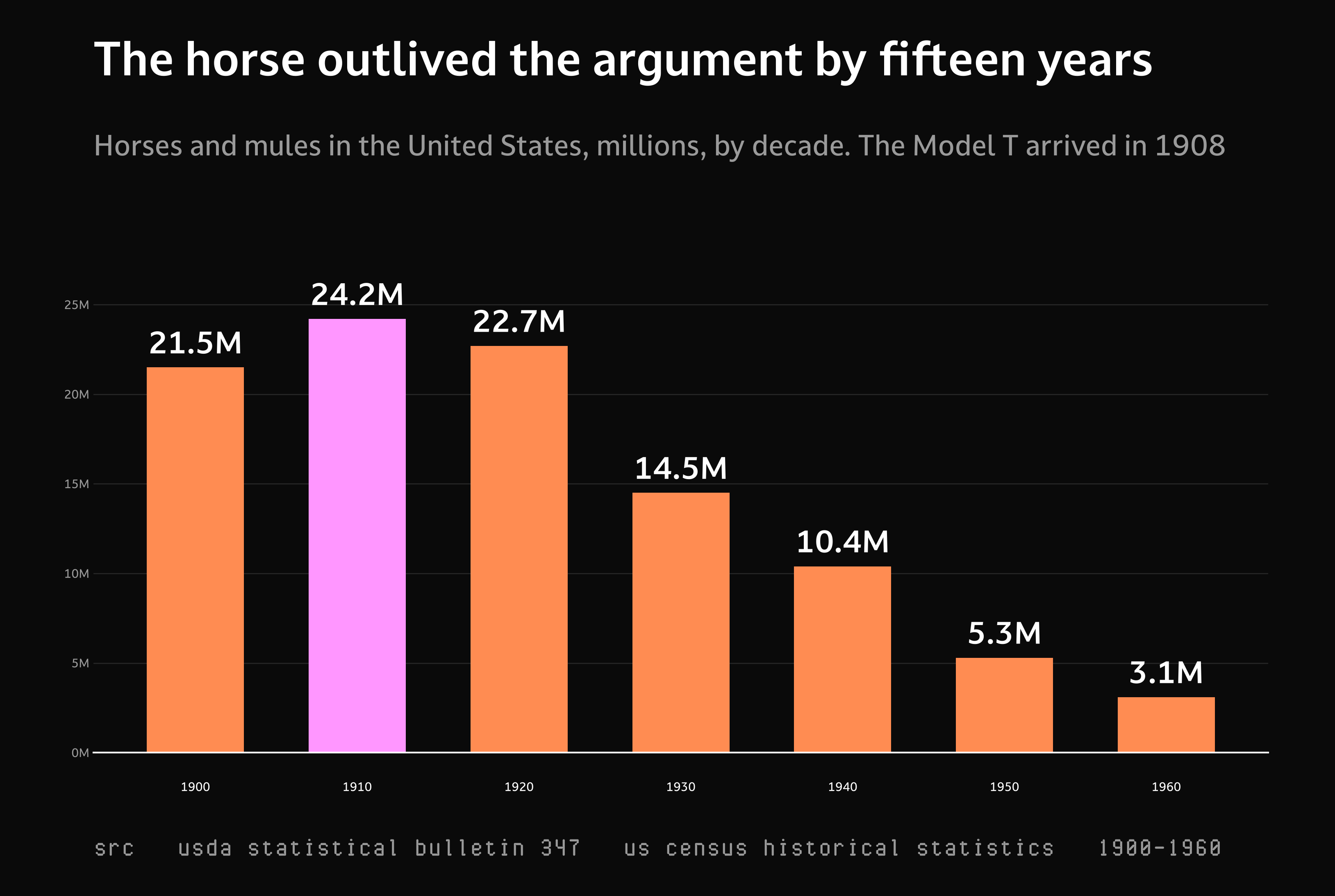
| 1900 | 21.5M |
| 1910 | 24.2M |
| 1920 | 22.7M |
| 1930 | 14.5M |
| 1940 | 10.4M |
| 1950 | 5.3M |
| 1960 | 3.1M |
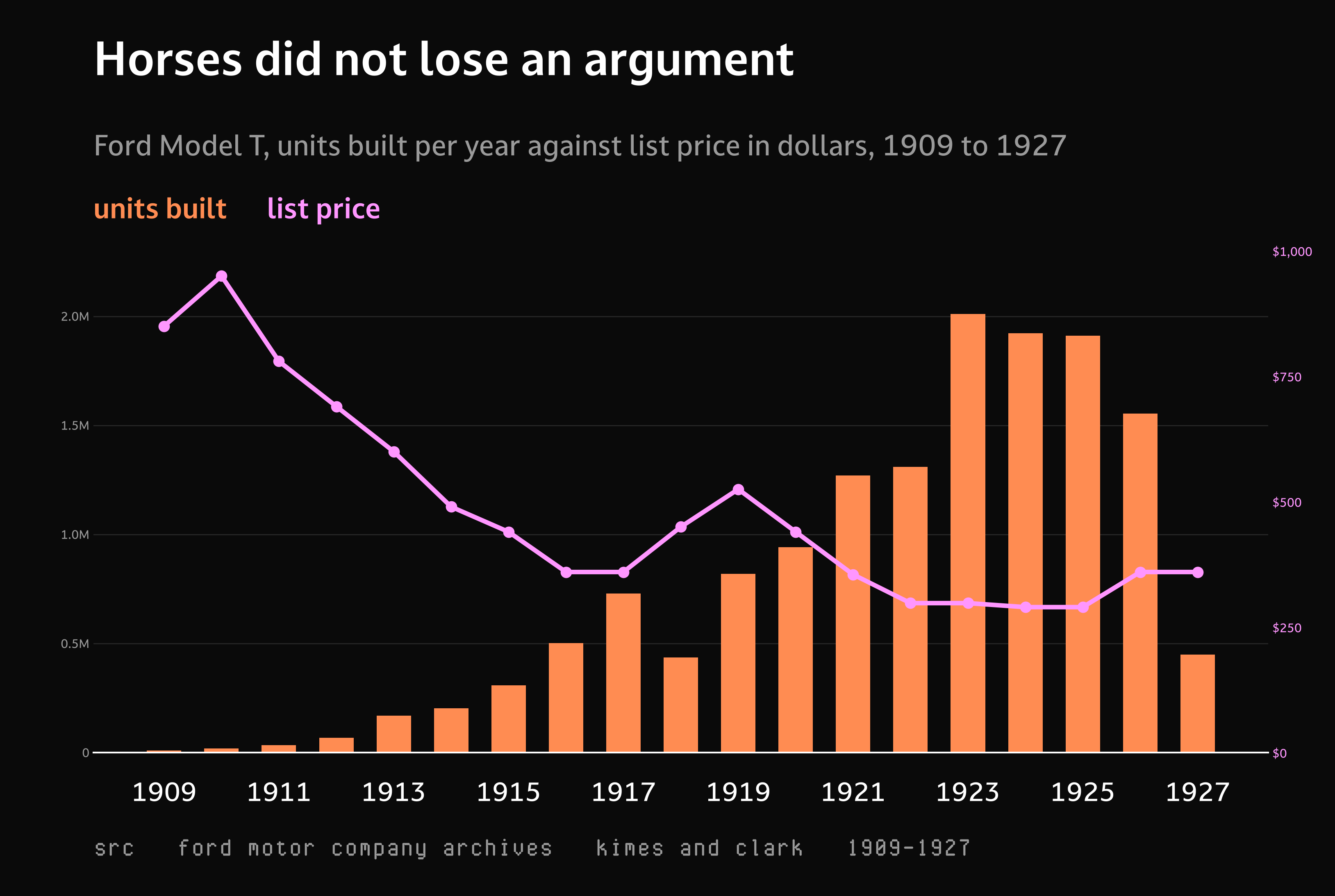
What the record does show is slower and stranger. Britain passed a law in 1865 requiring every motor vehicle to be preceded by a man on foot carrying a red flag, sixty yards ahead, at a speed no faster than two miles an hour in town. The flag was dropped in 1878 and the walking man in 1896, when the limit was raised to fourteen. The American horse population did not fall when the car appeared in 1908. It kept rising for another decade, past twenty-four million, and only began its long drop after the Model T’s price fell from $850 to $298 and its output passed two million a year. Horses did not lose an argument. They lost a price war, about fifteen years after the argument ended.
Which brings the paintbrush back. Photoshop shipped in 1990, eight years after a magazine had already moved a pyramid a few centimetres to fit a cover and been caught. Photographers said the tool would end the evidentiary photograph, and they were partly right. Within two years, people on Usenet were using the product’s name as a verb. The company spent the early 2000s asking writers to please say that an image had been manipulated using its software rather than say it had been photoshopped, which is the kind of request you make when you have already lost. The tool did not abolish photography. It abolished the assumption that a photograph had not been touched, and photography carried on inside the new assumption.
I have been thinking about why Photoshop never produced a word like slop, and the answer seems to be that it could not. Slop, the term, was circulating on message boards by 2022 and was given its working definition in 2024. Output that is unrequested and unreviewed. The definition says nothing about the model. It describes an absence of a person. Photoshop required someone to sit there and choose every pixel, so even its worst output (and it gave us a decade of lens flare) was somebody’s decision. A model will produce without a decision if you let it. Slop is not what the machine makes. Slop is what nobody chose.
That is the line the tool draws, and it runs straight through the current argument rather than around it. A generated image with a person behind it, making selections, discarding, returning, is a made thing in the same sense a retouched photograph is a made thing. A generated image with no one behind it is not made at all, only emitted. The artists refusing the tool are refusing the second thing, and the artists quietly using it are doing the first, and the survey numbers that look contradictory are describing two different activities that happen to share a product.
Whether either activity counts as creation is an older question, and it turns out to have an answer most of us have stopped consulting. Judaism, Christianity, and Islam agree on almost nothing doctrinally, and Maimonides observed that the one point they do share is that God alone makes from nothing. Genesis does not quite say so; its first verse has God ordering a dark and formless deep, and the doctrine of creation from nothing was only worked out in the second and third centuries, partly to win an argument with philosophers who said the universe had always been there. The Quran is more direct. It calls God the Originator of the heavens and the earth, the one who creates without a prior model, and lists three separate names for the act, the Creator, the Maker, the Fashioner, as if making were a trade with grades.
Humans were never on that side of the line. Every tradition puts the potter at the wheel with clay that was already there. Which means the painter and the model are on the same side of it, both rearranging material that existed before them, and the question of whether a machine can be original is, strictly, the wrong question. The scriptures never promised anyone originality. They promised that one maker worked from nothing, and the rest of us would have to make do with what was lying around.
The same books are mostly not about that at all. Of the 613 commandments counted in the Torah, a good share are municipal. Honest weights and measures. A railing around the roof of a new house so nobody falls off it. A latrine outside the camp and a spade to cover what you leave there. Seven days’ quarantine for a suspicious rash, inspected by a priest who functioned as a public health officer. What to do when an ox gores a man, with a different penalty if the ox was known to gore, which is negligence law, and which appears almost word for word in Hammurabi’s code a few centuries earlier. The Quran’s longest verse is a set of instructions for writing down a debt, with two witnesses, and not being lazy about small amounts. About five hundred of its verses are legal, and scholars count fewer than a hundred as core law. The rest of each book is story, and praise, and argument.
Read that way, a scripture is a constitution for a place that no longer exists, with the bylaws still attached. The railing rule made sense when roofs were where you slept in summer. The debt rule made sense when most people could not read and a scribe was a public utility. They are the cookie consent banners of their centuries (and the banners, give it time, will read as scripture to someone). Every age writes rules for the tool it fears, and the rules outlive the fear, and then they read as either sacred or clutter depending on whether you still have the fear.
The calculator ban on the exam paper was such a rule. So was the man with the red flag. So is the “no AI” badge on a portfolio, and the consent clause in a screen actor’s contract, and whatever gets written into copyright law in the next five years by people who are angry now. Some of those rules will hold. The consent ones probably should. Others will come to look like the flag, a reasonable precaution against a thing that turned out to be going two miles an hour.
Each of those tools was judged, for a while, by its worst output. Cars by the accident, horses by the kick in the teeth, the calculator by the child who could not add, the office computer by the typing pool it emptied. The ratio of fear to damage to need has been roughly the same every time, and so has the thing that closed the gap, which was never the tool improving. It was people learning what to ask of it. A model is not what it makes. It is how it is used, and the evidence that we already know this is the speed with which a new job title appeared to say so.
The person who calls themselves a prompt engineer today is the spreadsheet ninja of twenty years ago and the desktop publishing specialist of twenty before that, which is to say someone who learned the new tool early, named the skill before anyone else could, and will be embarrassed by the name in a decade while still using the tool. It is worth noticing what that early adoption is. Not confidence.
The people integrating the tool fastest are as afraid of being replaced as the people refusing it, and adopting is simply the form their fear takes, the way refusing is the form the other fear takes. Both are adaptation. The difference is that the adopter already lived in software, so the new tool was one more thing to learn, and the painter lived in their hands, so the same tool asks them to move house. Same threat, same instinct to survive it, and a very different distance to travel.
Suppose the order had been reversed. Suppose the breakthrough of this decade had come in robotics rather than language, and the machine that arrived could lay brick, throw a pot, and hold a brush, while writing and drawing on a screen stayed stubbornly human. The mason’s guild would be the one striking, the illustrators would be posting sympathetic threads, and the ratio of fear to damage to need would look exactly the same from the other side. Or suppose the bus drivers went first, every route in the city run without anyone at the wheel, while the rest of us kept typing our own sentences by hand for another generation. Which world is worse? The question has no scale to be weighed on, since every answer depends on which trade you happen to be standing in, and that is the point. The tool did not choose artists. It landed where the data was, and the data was words and pictures, because that is what we had spent thirty years putting online. Had we spent them uploading bricklaying, the flag would be walking in front of something else.
What nobody writes down is the fifteen years in the middle, when the teachers said yes and the exam board said no and the slide rule company kept its factory running anyway. That is where most of us are living at the moment. The tool is on the desk. The badge is on the website. Both belong to the same person, who has not decided yet and is, in the meantime, working.
Request an AI summary
Learn more about the ideas and references behind this note.
FAQ
- Do most artists oppose generative AI?
- Surveys from 2023 and 2024 show strong opposition to how models are trained, not to the tools as such. Around nine in ten authors, illustrators, and musicians want consent and payment before their work is used for training. In the same surveys, between one in eight and one in three report using generative tools in their own practice. Opposition to the terms and use of the product coexist.
- Was there real resistance to pocket calculators in schools?
- Yes, but not mainly from teachers. A 1975 survey found about two-thirds of mathematics teachers already favoured classroom calculators, rising to 72 percent by 1977, and the National Council of Teachers of Mathematics endorsed them in 1974 and again in 1980. The holdouts were parents, newspaper editorials, and exam boards. The SAT did not allow calculators until 1994, two decades after the devices reached the classroom.
- What are some related topics to explore?
- artists against generative aipocket calculator resistance in schoolsslide rule obsolescence 1976ai slop meaningcreatio ex nihilo human creativitytechnology adoption resistance history
Defined Terms
- Slop
- Generative AI output that is published unrequested and unreviewed, named by analogy with email spam.
- Creatio ex nihilo
- The theological doctrine that God created the world from nothing rather than by shaping pre-existing matter, held in common by Judaism, Christianity, and Islam.
Foundations
- An Agenda for Action: Recommendations for School Mathematics of the 1980s
- National Council of Teachers of Mathematics, 1980
- Creatio ex Nihilo: The Doctrine of Creation out of Nothing in Early Christian Thought
- Gerhard May, 1978 (English translation 1994)
Related Reading
Related Notes
- The Alarm That Never Learns
- Every generation fears new tech will ruin the next. From Socrates on writing to the 1916 push button, the alarm rarely predicts what actually gets lost.
- The Jockey and the Absurd
- A friend with betting slips in one hand and philosophy books in the other. Horse racing and existentialism both confront forces you cannot control.
- The Efficiency of Being Inefficient
- Ordering coffee from a screen while a barista stands right there. Silicon Valley declared friction the enemy. It never asked what friction was doing for us.