
The Two Stripes at Molineux
What Happens to Soccer's Money When You Change Who Owns the Clubs, and What Does Not
UEFA distributes European club revenue on a fixed ladder that pays rank one thirty-six times what it pays rank thirty-six. Member ownership, state ownership and investor ownership have all produced the same concentration.
Ahead of a European Cup tie at Molineux in 1959, officials of the East German army club Vorwärts Berlin bought Adidas boots for their players, and then bought a tin of black polish the day before the game. The German Democratic Republic made poor soccer boots and everybody involved knew it. What could not be shown to fifty-six thousand people in the English Midlands, with the television cameras running behind them, was a West German trademark on the feet of the socialist champions, so the three stripes were painted down to two.
A planned economy with no advertising industry, no private capital and no transfer market had travelled to Wolverhampton and found itself managing a branding problem within a day of arrival.
Nobody was fooled for long, and it hardly mattered. The standard being met had been set somewhere else, and owning the club differently bought no exemption from it.
Sixty-seven years later, the money in European soccer is divided by a document. For the 2025/26 season UEFA works from an assumed gross revenue of 4.4 billion euros across its three club competitions and the Super Cup. After costs, qualifying-round payments and a solidarity share for clubs who never made it, 3.317 billion goes to the clubs who did. Of that, 2.467 billion belongs to the Champions League.
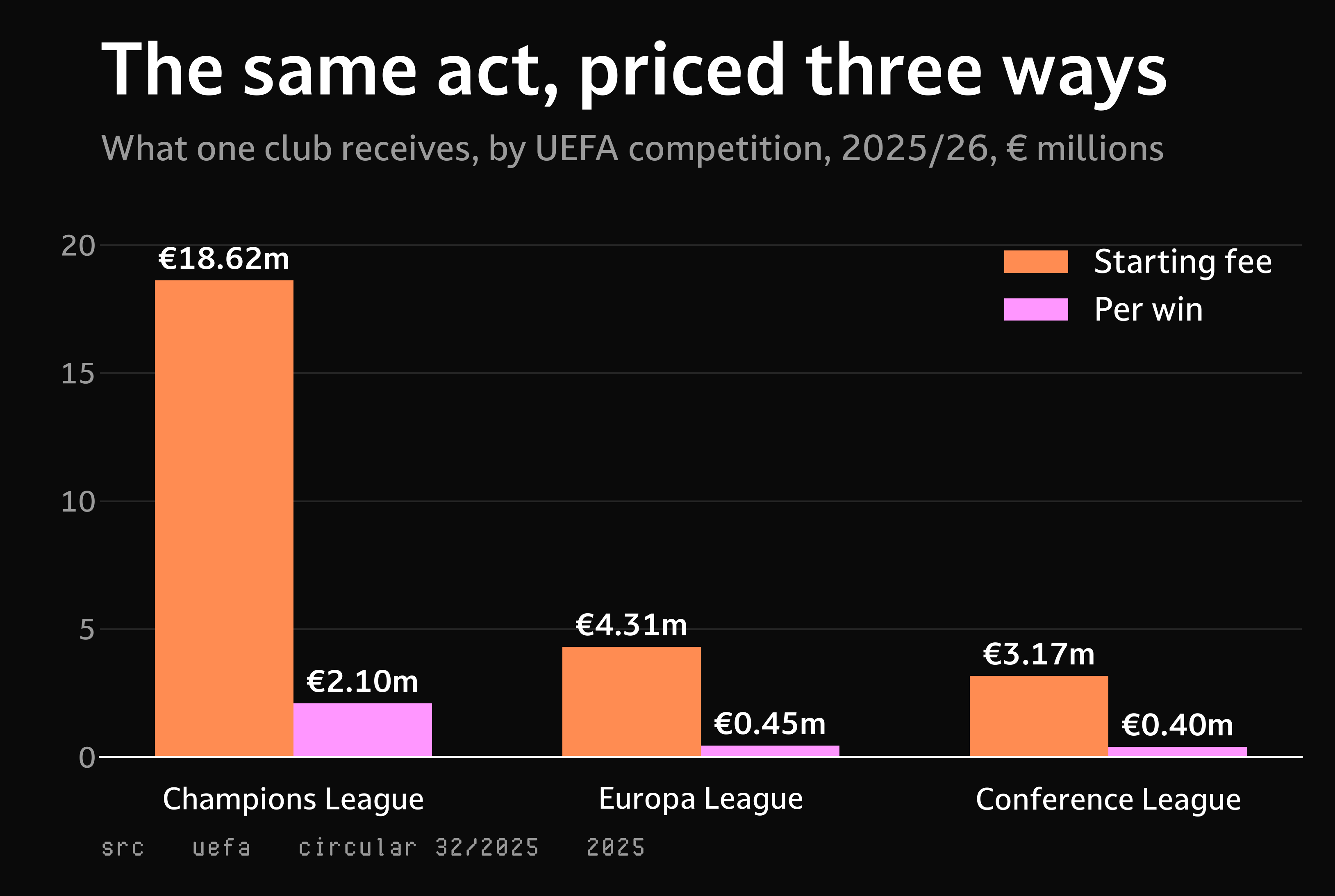
Some of it is distributed the way a sports competition would suggest. Each of the thirty-six clubs in the league phase receives a starting fee of 18.62 million euros. A win pays 2.1 million, a draw pays 700,000, and reaching the final pays 18.5 million on top.
Then there is the value pillar, worth 853 million euros, and it works on a different principle. The pot is cut into 666 shares, which is the sum of every number from one to thirty-six. The lowest-ranked club receives one share. Every place higher adds another, so the top-ranked club receives thirty-six.
At 1.28 million euros a share, that is 46.1 million euros for the club at the top and 1.28 million for the club at the bottom, from the same pot, in the same competition, in the same season.
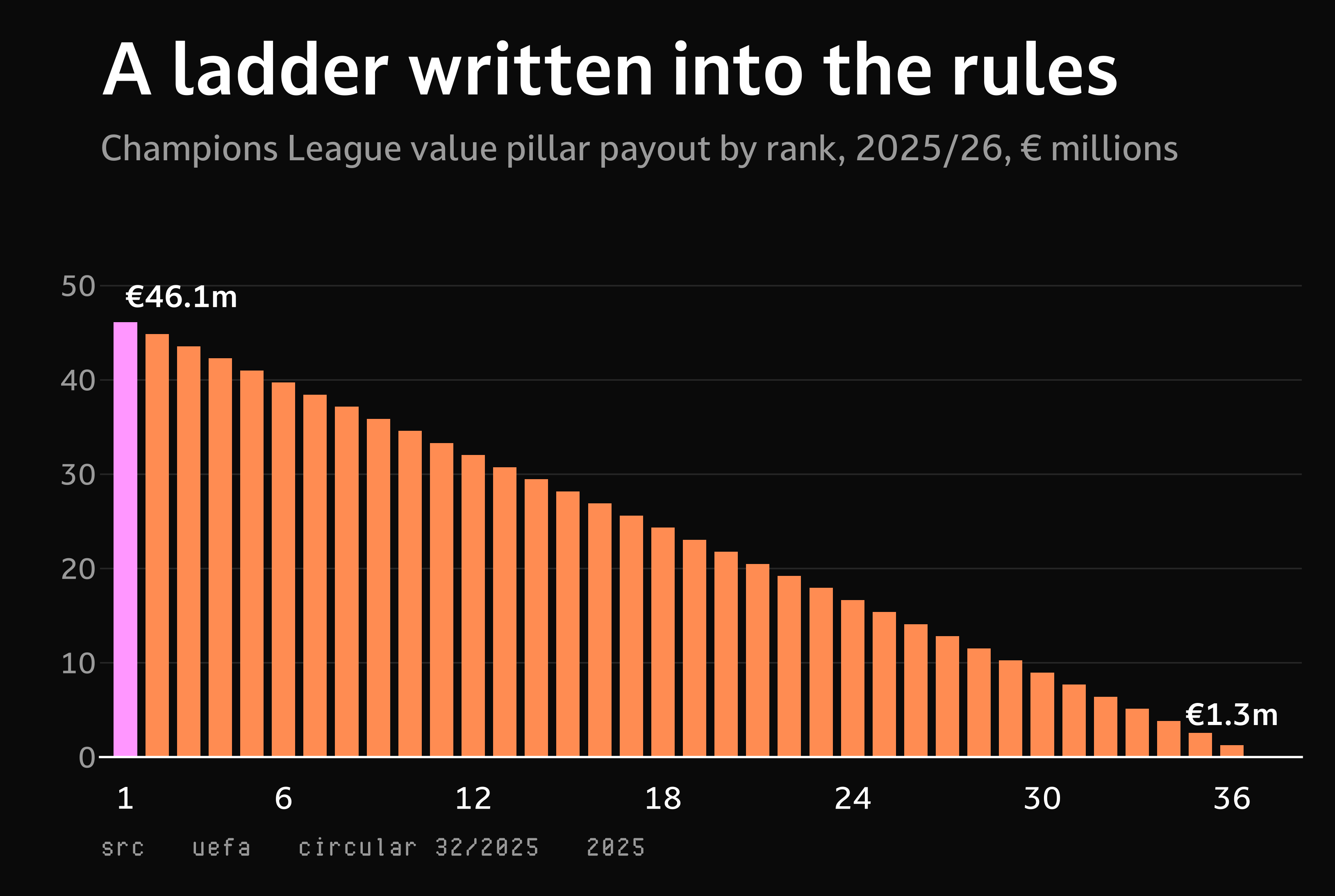
Data
| Rank | Shares | Payout |
|---|---|---|
| 1 | 36 | €46.1m |
| 8 | 29 | €37.1m |
| 16 | 21 | €26.9m |
| 24 | 13 | €16.7m |
| 32 | 5 | €6.4m |
| 36 | 1 | €1.28m |
Position on that ladder is not decided by results. It is set by how much a club’s national broadcasters contribute to UEFA’s media revenue and by how often the club has been in these competitions over the previous five and ten seasons. A club is ranked, in other words, on having had money and on having been there before.
The same logic scales down the pyramid. Qualifying for the Champions League is worth 18.62 million before anyone kicks anything, while the same achievement in the Conference League is worth 3.17 million, and a win in one is worth five times a win in the other.
Calling this a monopoly is not a radical position any more. In December 2023 the Court of Justice of the European Union found that UEFA and FIFA hold a dominant position in organizing European club competition, and that their rules for approving rival tournaments restricted competition by their object. The critique went to Europe’s highest court and won. The ladder did not move.
So the question of what to do about it stays open, and the two most confident answers disagree with each other completely. One says the fix is more centre. A stronger governing body with statutory redistribution, capped media rights and continental wage bands. The other says the fix is no centre at all. Federated leagues, rotating councils, clubs run by assemblies of the people who turn up.
Both call themselves the answer to the same problem. Only one of them can be describing a world where UEFA still exists.
Soccer has already run most of the experiments. Germany has spent decades under a rule requiring members to hold voting control of every club, and a study of forty-seven Bundesliga clubs across thirty seasons found no equalising effect whatsoever. Financial and competitive imbalance both grew after the rule arrived. Bayern Munich won eleven league titles in a row.
Multi-club ownership has been tested the same way, across 2,060 club-seasons in forty-six leagues, comparing clubs inside investor networks against matched clubs outside them. No systematic advantage, in any network structure, under any owner type. And Barcelona, owned by its members for its members, spent two decades selling off its future revenues, borrowing against its own subsidiaries, treating its players as amortizing assets and its non-playing staff as a cost to be compressed. Nobody had to buy the club to financialize it.
The one measure that did flatten soccer was a wage cap. English clubs operated under a maximum wage of twenty pounds a week until January 1961, when the players threatened to strike and the League folded within days. Johnny Haynes was on a hundred pounds a week almost immediately. The ceiling came down because organized labour pulled it down, which sits awkwardly beside the usual account of who such ceilings protect.
I keep returning to the polish rather than the boots. Every remedy that rearranged ownership left the outcome untouched, and the remedies that touched the money kept producing results nobody ordered.
When UEFA introduced its break-even rule in 2010, requiring clubs to live within soccer revenue, it did roughly what removing a billionaire’s chequebook would do. Modelled across four major leagues, the result was lower wages, higher club profits, no meaningful gain in competitive balance, and a firmer grip for the clubs already at the top, because a wealthy backer was the only route by which a smaller club had ever caught them. The authors describe it as shifting money from players to owners with nothing delivered to anyone watching.
Whether redistribution helps at all has been argued for seventy years without resolution. Simon Rottenberg, writing about baseball in 1956, worked through a league that pooled and shared all revenue equally and concluded that no club would then have any reason to win, since the slice arrives regardless, so every club would buy the cheapest players available and the audience would go and do something else. Stefan Késenne, in 2000, ran the same question and found that revenue sharing improves competitive balance under every assumption he tested. Both are in print. Neither has won.
Meanwhile the East Germans, who had abolished all of it, watched Berliner FC Dynamo win ten consecutive championships from 1979 to 1988. The club belonged to the Ministry for State Security. Referees were selected for particular fixtures, players were moved in from across the country, and a secret federation study later confirmed the favouritism. Supporters called them die Schiebemeister, roughly the fixed champions, and stopped coming.
Members owning the club produced eleven in a row. The state owning the club produced ten in a row. The market produced a ladder that pays first place thirty-six times what it pays last. Three arrangements with nothing in common, and one shape.
The binary underneath the whole argument has meanwhile stopped existing. Newcastle United is owned by a Saudi sovereign wealth fund. Paris Saint-Germain is owned by a Qatari one. These are state assets, publicly held in the most literal available sense, and they behave nothing like anything the case for public ownership predicts. Common ownership is not a direction of travel. It is a question about whose commons, and the answer in 2026 is usually a ministry several thousand kilometres away.
The people who study this are careful to point out that it takes two. Sovereign funds can buy European clubs because European soccer arranged itself to be bought, and the openings were built by the same commercial order that now finds the buyers distasteful.
None of which means supporter ownership is a failure. It was never sold as a parity mechanism. It keeps tickets affordable, it gives members a vote that a shareholder structure would take away, and the fan movements that grew out of resisting all this have turned into something closer to political projects than customer complaints. Judging it on whether it evens out a league measures it against a promise it never made.
But the ladder is still a ladder. It pays for having been paid, and it will do that under any ownership anyone has yet devised, because the arithmetic sits above the ownership and always has.
At Molineux the boots worked fine. Vorwärts lost anyway, and somewhere in a kit bag on the way home there was a tin of black polish, most of it still unused.
Request an AI summary
Learn more about the ideas and references behind this note.
FAQ
- How does UEFA divide Champions League money between clubs?
- Four ways. An equal starting fee of 18.62 million euros for each of the 36 clubs in the league phase, performance money of 2.1 million per win and 700,000 per draw, a ranking bonus, and a value pillar worth 853 million euros. The value pillar is split into 666 shares and handed out on a ladder. The lowest-ranked club receives one share, the highest receives thirty-six. Position on that ladder is set by how much a club's national broadcasters contribute and by its participation in previous seasons.
- Does fan ownership make a soccer league more competitive?
- The evidence says no. A study of 47 Bundesliga clubs across thirty seasons found the German 50+1 rule produced no equalising effect at all, and that financial and competitive imbalance both grew after it came in. Bayern Munich won eleven consecutive titles under that rule. Supporter ownership does other things, including keeping ticket prices down and giving members a vote, but competitive balance is not among them.
- What are some related topics to explore?
- uefa champions league revenue distribution50+1 rule german soccercompetitive balance european soccerfinancial fair play break-even rulesovereign wealth fund soccer ownershipbfc dynamo stasi east german soccer
Defined Terms
- Value pillar
- The portion of UEFA's club competition revenue, 853 million euros in 2025/26, that is distributed by ranking clubs against each other rather than by what they do on the pitch.
- Invariance proposition
- The argument, first made about baseball in 1956, that restrictions on how clubs buy players change who captures the money without changing where the talent ends up.
Foundations
- The Baseball Players' Labor Market
- Simon Rottenberg, 1956
- Financial Fair Play in European Football
- Thomas Peeters and Stefan Szymanski, 2014
Related Reading
Related Notes
- The Billion-Dollar Local Club
- Soccer once belonged to neighbourhoods. Your street, your city, your pride. Then globalization found the sport and the local club became a billion-dollar brand.
- The Man With the Red Flag
- Nine in ten writers want to be paid when their books train a model. One in eight already uses one. The last American slide rule was made in 1976 and handed to a museum, and the engineers who swore by it bought calculators anyway. Refusal and adoption have always shared a desk.
- The Strike Capital Started Without Us
- AI is the first technology that makes labour optional to capital. The working class keeps debating distribution when the real fight is over ownership of what replaces us.