
The Country That Runs on Newcomers
How Canada Engineered a Dependency It Is Now Trying to Slow
Canada's population no longer replaces itself, so growth comes almost entirely from immigration. Quebec, Germany, France, Türkiye and Japan face the same demographic arithmetic and each denies it differently.
In the first quarter of 2025, more people died in Canada than were born, and the country grew anyway. The gap between the deaths and the births came to 5,628, the first time outside a pandemic that the arithmetic had run in that direction, and it passed almost without comment. The population still climbed past forty-one million, because the shortfall was made up entirely from outside the country. A nation had reached the point where it could no longer reproduce its own numbers, and had quietly arranged for that not to matter.
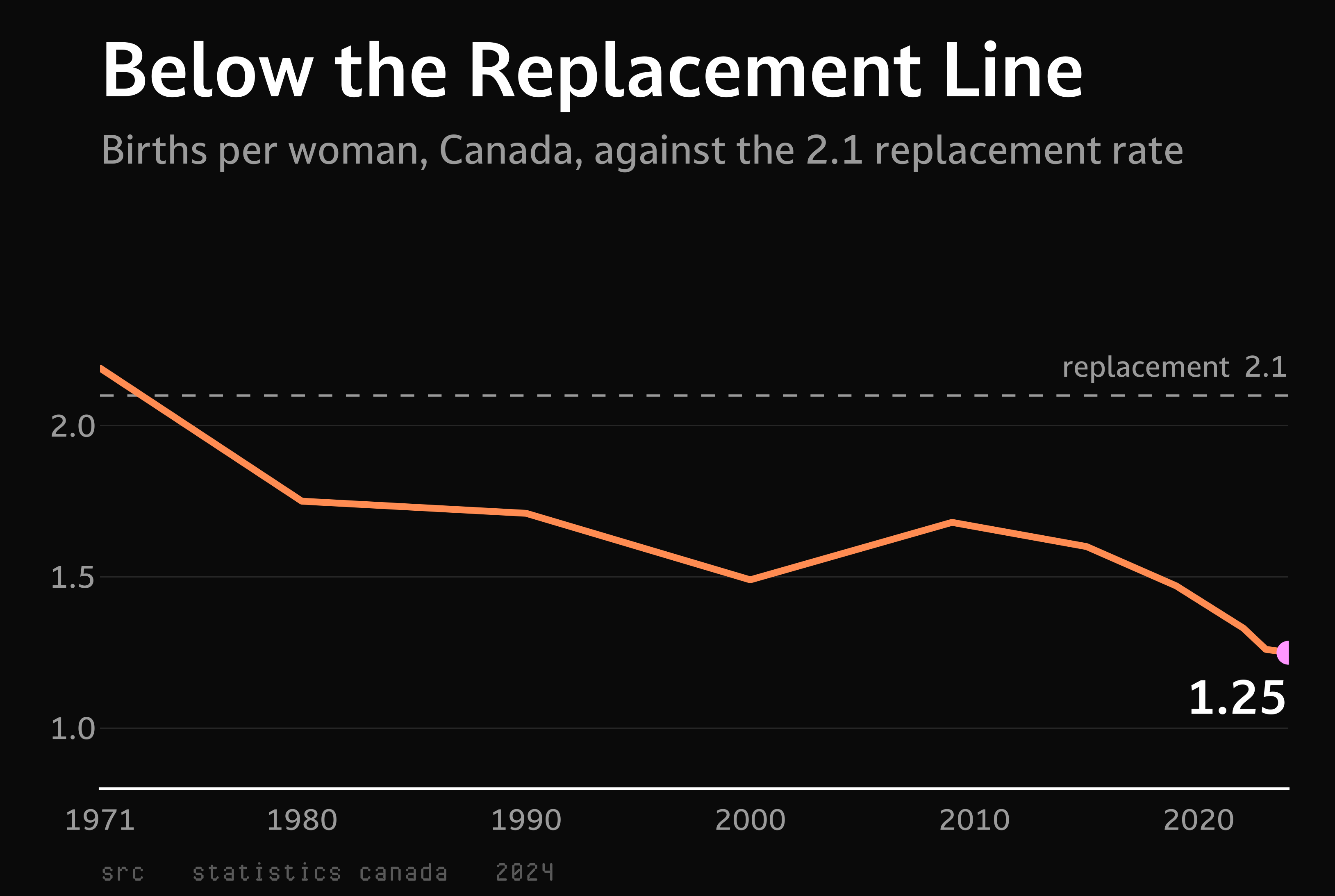
The birth rate had been sliding toward this for years. Statistics Canada put the total fertility rate at 1.25 children per woman in 2024, the lowest ever recorded, and a long way beneath the 2.1 that a population needs to hold its size unaided. This is not a single bad year. The line has bent downward since 2009, through strong economies and weak, across provinces with cheap housing and dear, which points to a cause sitting deeper than any one policy could reach.
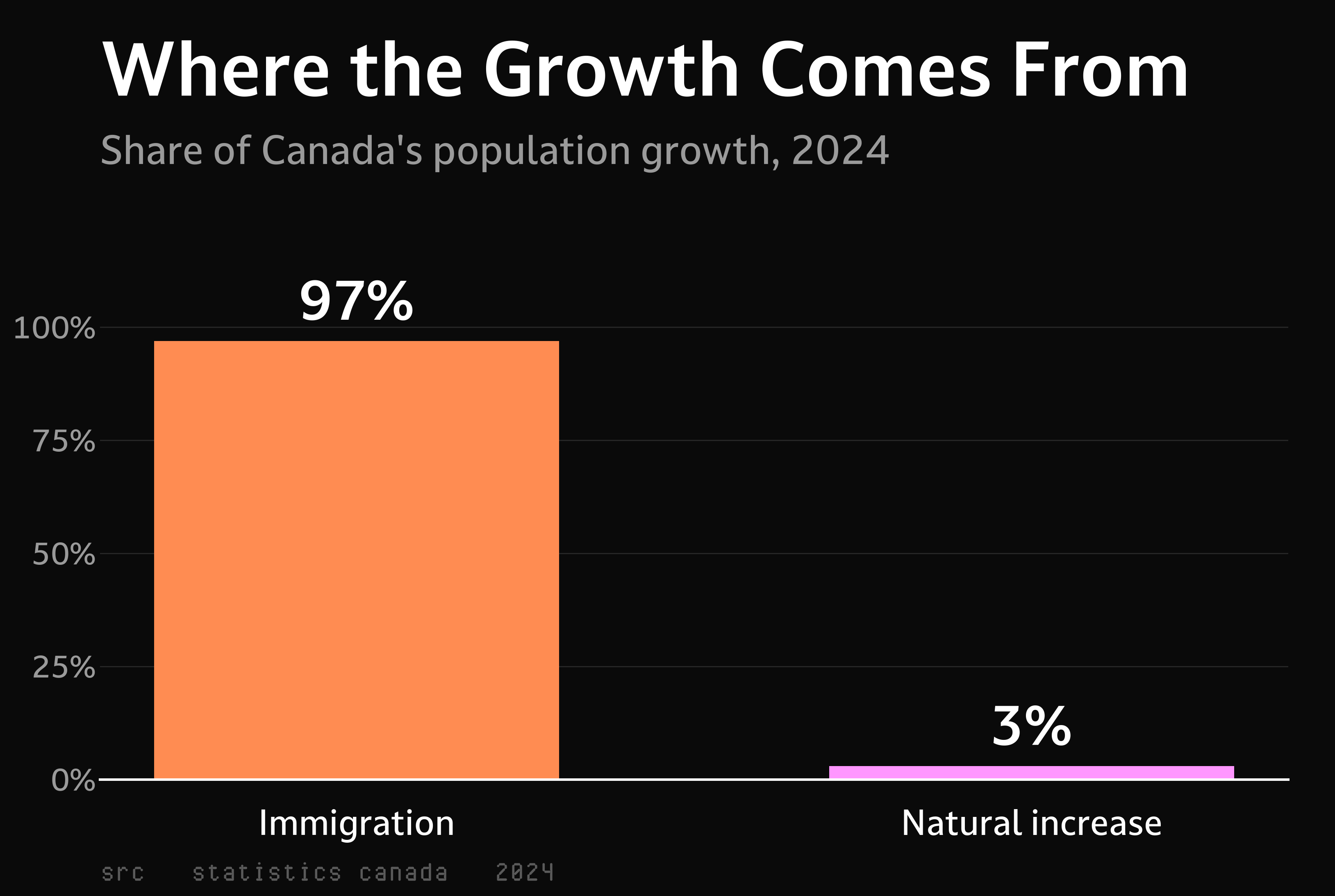
So the growth arrives by plane. Of every hundred people Canada added in 2024, roughly ninety-seven came through immigration and about three through birth, a ratio that would have read as a misprint a generation ago. The oldest machinery a country owns for renewing itself, the plain surplus of births over deaths, has been worn down to a rounding error, and the rounding has begun to slip below zero.
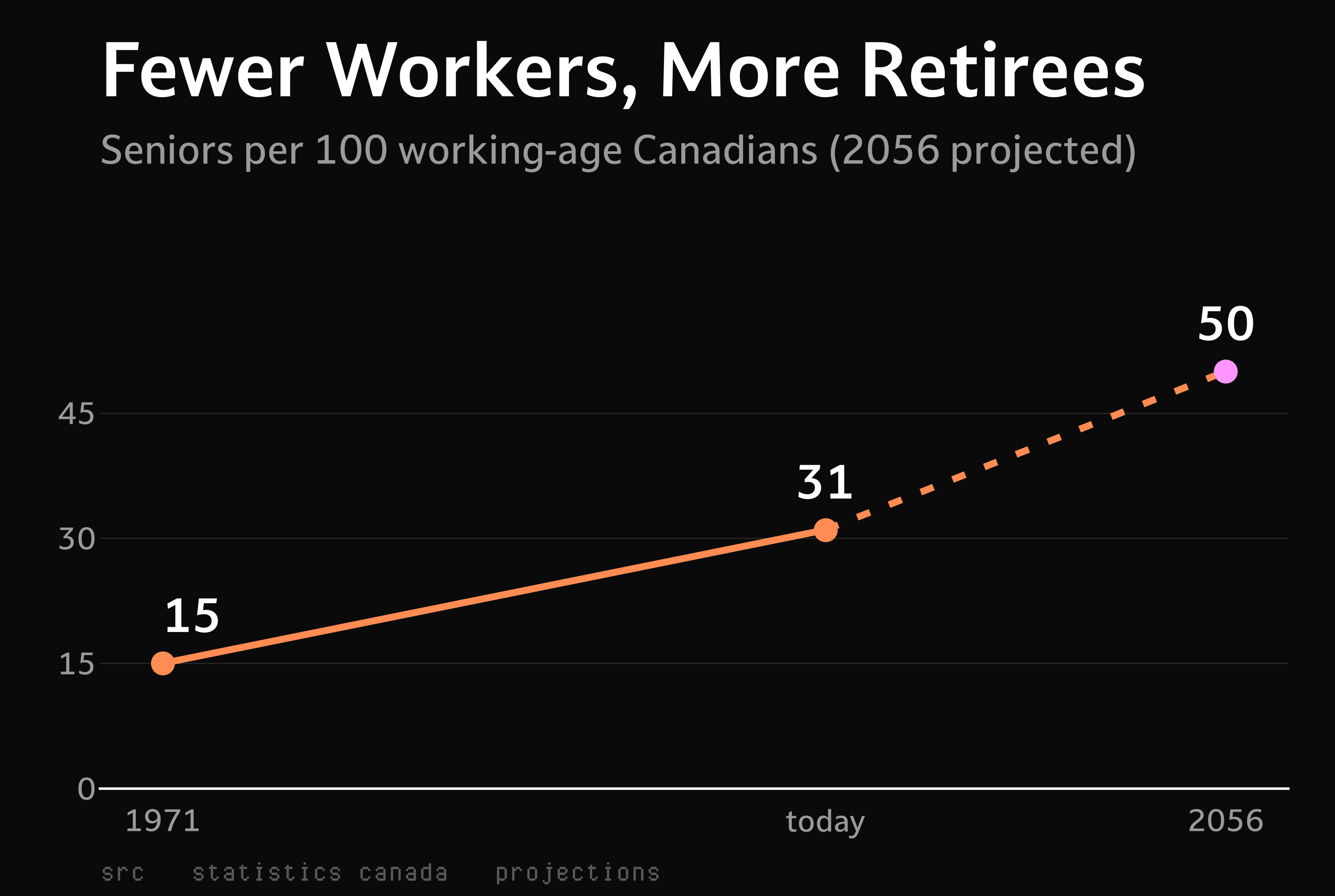
None of this is passing weather. In 1971 there were about fifteen Canadians past sixty-five for every hundred of working age. Today there are close to thirty-one, and the official projections carry the figure toward fifty by the late 2050s, the point at which two workers support each retiree rather than the seven of living memory. Pensions and hospitals are paid for by people in the middle of their working lives, and that middle is thinning. The only lever that refills it quickly, short of a baby boom no wealthy country has managed to conjure, is to bring the workers in already grown.
The arrangement is plainest on a hospital ward at three in the morning. The fastest-growing corner of immigrant work in Canada is care, the turning and lifting and feeding of an aging population, and for much of the past decade the country’s largest single source of newcomers has been the Philippines. The generation that did not quite replace itself is being tended, in its last years, by the people it invited in to cover the difference. Their taxes hold up the pensions. Their hands hold up the patients. The dependency is not a figure on a spreadsheet. It has a face and a night shift.
What sets Canada apart is not the dependency, which it shares with most of the rich world, but its willingness to say so aloud. Doug Saunders argued in Maximum Canada that the country spent a century and a half in the grip of what he called a minimizing impulse, a preference for staying small, closed and resource-bound that bled it of people and prosperity for generations. The modern reply, taken up across party lines, was to reverse that impulse on purpose and steer toward a hundred million Canadians by the end of the century. The Century Initiative gave the number a lobby. Ottawa gave it an intake machine. For once a country facing demographic decline chose expansion deliberately, and said as much.
The difficulty is that Canada adopted the number and skipped the preparation. Saunders had been careful to warn that the last great tripling of the population, from twelve million after the war to thirty-five, ran largely on luck, on cheap housing and plentiful work that happened to arrive at the right time, and that the next expansion would demand deliberate investment or curdle into something unequal and strained. The investment did not follow. Home building fell so far behind arrivals that the country was adding several residents for every dwelling it finished, and the projected shortfall by 2030 runs into the millions of units. Output per person fell for most of two years even as the whole economy grew, the reliable sign of more people dividing a pie that had not widened to match. The maximizing ambition had been built on the minimizing effort.
Then, late in 2024, the country flinched. The government cut permanent admissions from a planned half-million toward 395,000, set the first hard caps in its history on temporary residents, and pledged to shrink that group from roughly seven and a half percent of the population back toward five. A place that had spent a decade selling growth as destiny discovered that destiny had to be housed, and pulled back. The dependency did not lift. Only the confidence did.
The sharpest version of the contradiction sits inside Canada, in Quebec. The province leans on newcomers more completely than the country does. Its own fertility rate fell to 1.33 in 2024, deaths outnumbered births for the first time in its modern history, and every last increment of population growth that year came from migration. Yet Quebec spends the arrangement arguing with it. Under a 2022 language law, arrivals are given six months to conduct their official business in French, and the government has set itself the goal of admitting almost none but French-speaking economic immigrants. What it has not done is teach them the language. The system it launched to provide French classes was overwhelmed on arrival, waiting times stretched from about a month to nearly four, tens of thousands sat on lists, and in the same season the government trimmed the funding that pays people to attend. The province wants French speakers and declines to produce them. Its premier calls the temporary-resident surge a breaking point and demands Ottawa halve it, while in the Plateau district of Montreal the locals grumble about the arrivals from France, who carry euros into a cheaper rental market and pay the higher rents without flinching, easing everyone else out. A society can resent the people it runs on with remarkable precision.
Canada is not the first country to run into this arithmetic, only the most candid about it. Germany met it in 1961, when it signed an agreement to bring Turkish workers in on a two-year rotation, on the understanding that they were labour rather than settlers, guests who would leave before they belonged. Roughly 867,000 came before recruitment stopped in 1973, about 500,000 went home, and the rest stayed, sent for their families and raised German-born children who were somehow still counted as visitors. For forty years the official line held that Germany was not a country of immigration. The Swiss writer Max Frisch had named the mistake a generation earlier. A country asks for workers, and human beings arrive instead. It took until 2001, and a government commission, for Germany to concede that the denial had become untenable. Today, with its own birth rate at 1.35 and its postwar generation retiring in a wave, Germany chases something near four hundred thousand newcomers a year and has built one of the most aggressive recruitment systems anywhere to find them. The country that swore the workers were temporary now cannot get enough of them.
France practises a quieter form of the same denial. A recent Terra Nova study, published in book form as Sans eux by Thierry Pech, Hakim El Karoui and Guillaume Hannezo, argued that whole reaches of the French economy would simply stop without immigrant labour, the care homes and building sites and delivery routes the native-born have largely left behind, and that France needs on the order of three hundred thousand arrivals a year to keep its pensions and services solvent. The dependence is total and the acknowledgment is partial, tucked beneath a national story about assimilation that would rather not notice who does the work.
Türkiye shows the same pattern in a country with no long history of the argument. It took in the largest refugee population on earth, close to three million Syrians under temporary protection at the last count, and in 2016 agreed to stand as Europe’s gatekeeper, holding back the people the continent would not admit in exchange for money and the promise of easier travel. For a while the hosting was framed as a duty. Then the economy soured, and the rest followed the familiar script. Syrians were blamed for wages and rents, discontent climbed across every party line, and a movement built entirely on the promise to deport them dragged the mainstream toward talk of voluntary return. What makes Türkiye the sharpest case is the other half of its ledger. Its own birth rate has sat below replacement for years and keeps falling, while its most educated citizens leave in growing numbers, the engineers and biologists and coders bound for Germany and the United States and Canada. The country is a reluctant host and a bleeding source at once, taking in the refugees Europe fears while exporting the graduates it can least spare, resenting the first and barely noticing the second.
Japan is the control case, the country that chose the other path. Where Canada spent the postwar decades opening, Japan stayed closed, a near-sealed ecosystem of the kind Saunders said old Canada had wished to be, and it has been shrinking ever since. Its population fell by more than half a million in a single recent year, births dropped under seven hundred thousand, and the fertility rate touched 1.20. Refusing the newcomers did not spare Japan the arithmetic. It delivered the bill as disappearance rather than friction. And the seal is cracking regardless. A record thirty-seven million tourists arrived in 2024 and promptly wore out their welcome, a rice shortage emptied the shelves of the country’s most guarded staple, and the government, quietly desperate for workers, more than doubled the number of foreigners it will let in to drive its buses and tend its farms. The nation that refused to import people is now importing them, later and more grudgingly, to do the work its vanishing young will not.
It would be neat to end on the tidy answer, that the fix is simply more of the same, except that immigration does not actually cure the condition it is hired to treat. Newcomers age too. Their birth rates, within a generation, drift down to meet the low local ones, so leaning on arrivals to correct the balance of workers and retirees is less a repair than a standing subscription, a lever that has to be pulled a little harder each year to hold the same position. And the pulling has grown less rewarding. Immigrant incomes in Canada once caught up to the national average within about fifteen years. That convergence broke down around 1990, and recent arrivals are more likely than the citizens whose retirements they underwrite to end up poor. The country is built around a mechanism that keeps it upright without ever letting it rest.
What runs through all of them is a single, awkward symmetry. The volume of the argument tends to rise with the depth of the need. Germany swore the workers were temporary while it turned into a country of immigration. Quebec demands French speakers it will not teach, and resents the arrivals keeping its province from shrinking. Türkiye scapegoats the refugees it shelters while its own future boards flights out. Japan kept the door shut and grew old instead. The complaint is loudest exactly where the dependence runs deepest, and it never quite reaches the arithmetic, which is the one party in the room with no interest in the conversation.
On the ward at three in the morning, none of the argument is audible. The woman turning the patient and the patient being turned are two halves of one equation, and only one of them was born here.
Request an AI summary
Learn more about the ideas and references behind this note.
FAQ
- Is Canada economically dependent on immigration?
- Yes. Canada's total fertility rate fell to a record 1.25 in 2024, far below the 2.1 needed to hold a population steady, and in the first quarter of 2025 deaths outnumbered births. Roughly 97 percent of the country's 2024 population growth came from immigration, and immigrants account for nearly all net growth in the labour force. Because the population is aging, the working-age tax base that funds pensions and health care can only be refilled quickly by bringing in workers who are already grown.
- Why did Canada cut immigration in 2025 if it depends on it?
- Population growth outran housing and infrastructure. Home building fell far behind arrivals, and output per person declined for most of two years even as the total economy expanded. In late 2024 the government cut permanent resident targets toward 395,000 and, for the first time, capped temporary residents, aiming to reduce them from about 7.5 percent of the population to 5 percent. The demographic dependency did not disappear. The political appetite for rapid growth did.
- What are some related topics to explore?
- canada immigration dependencyrecord low fertility rate canadaold-age dependency ratio2025 immigration levels plangastarbeiter germany turkish workerssans eux immigration economy
Defined Terms
- Natural increase
- The number of births minus the number of deaths in a population over a set period, before any migration is counted.
- Old-age dependency ratio
- The number of people aged sixty-five and over for every hundred people of working age, a rough measure of how many workers support each retiree.
Foundations
- Maximum Canada: Why 35 Million Canadians Are Not Enough
- Doug Saunders, 2017
- Les travailleurs immigrés : avec ou sans eux ?
- Terra Nova, 2025
Related Reading


Related Notes
- The Politics of the Dropdown
- A complaint arrived through the contact form of blogroll.blog about the wrong flag on a listed blog. The flag was drawn by a standard, the standard follows the United Nations, and the United Nations inherited a fight from 1971. There is no neutral country list. The dropdown has already chosen.
- The Day We Used to Dance
- May 1 was a fire and a maypole long before it was a slogan. The eight-hour workday demand asked for three blocks of time. Two got walls around them. The third quietly slipped through the calendar and ended up somewhere else.
- The Headline That Ate the Story
- Moby Dick gets retitled as 'How One Man's Obsession with a Whale Destroyed His Crew'. The grammar is older than the algorithm, lifted from grocery-aisle paperbacks decades before the recommendation feed showed up. The feed only taught us, slowly, that the templates work.