
The Feeling Was the Product
How Institutions Sell the Feeling of Virtue Instead of Paying Its Cost
Land acknowledgements, personal carbon footprints, and corporate rainbow logos are three versions of one tactic. Manufacture a private feeling of virtue or guilt so the institution never has to change or spend.
The man had been moving down the line of us for a while before it was my turn. This was somewhere in the long middle of the pandemic, the sidewalk half empty, everyone standing a careful distance apart, and he went from person to person, leaning in close to each face and saying something I could not make out. He was Indigenous, and he was furious, and the words did not survive the space between us. What survived was the fury, and the fact that not one of us could honestly have claimed to be surprised by it. Nobody knew exactly what he was saying. Everybody had a guess.
I have thought about that morning more than I expected to. Not because I understood him, which I did not, but because of what I did afterward. I put a land acknowledgement on my website, a line at the bottom of every page naming the nation whose territory this city sits on, quiet and permanent and correct. It took an encounter I could not hold and turned it into something I could, two tidy sentences, formatted and filed. The man was the unbearable version. The footer was the manageable one.
This is roughly the objection a Native writer named Reid Walker raised recently about the practice as a whole. A land acknowledgement is meant to name a dispossession, and in the naming it often does the opposite. It settles the matter. The history gets spoken aloud, and in being spoken it feels handled, absorbed, closed. A ritual built to disturb becomes a ritual of reassurance, and the people in the room, having heard the hard thing said, are free to feel the hard thing has been dealt with.
The form itself carries the confusion. The practice reached North America partly through Australia, where two gestures are kept apart. A Welcome to Country, which only a traditional owner of that land can give, and an Acknowledgement of Country, which visitors offer in return. One is the host speaking, the other the guest. The version that took hold here collapsed the two, so institutions built on the land now perform the welcome, as though the estate could greet its own dispossessed. My footer does exactly this. It speaks as a host on ground where, in any honest accounting, I am the guest.
None of which would matter if the words were the beginning of something. Walker’s real point is not that acknowledgements are false but that they tend to stop precisely where the cost would begin. The test is not the sentence, it is what follows it, and in Canada what follows is mostly more sentences. The Truth and Reconciliation Commission issued ninety-four Calls to Action in 2015. A decade on, the number completed sits around thirteen, depending who is counting, a pace that would finish the list somewhere in the 2070s. The inquiry into missing and murdered Indigenous women and girls produced two hundred and thirty-one Calls for Justice, of which the number fully met, years later, is two. Federal spending tied to that inquiry is set to fall from a peak near three and a half billion dollars to under two by the end of the decade, arranged quietly by letting programs expire rather than announcing their end. Meanwhile dozens of First Nations still cannot drink their tap water, and the budget officer has priced the annual gap to fix it at a hundred and thirty-eight million dollars, a sum the country acknowledges the land but declines to spend.
The words are under attack from the other side as well, for the opposite reason. A state law recently pushed Ohio’s largest university to ban most acknowledgements, and a White House report this summer scolded the Smithsonian for describing the country’s founding as a theft of Native land. That side wants them gone for saying too much. Walker wants more than them for doing too little. Both are pointing at the same gap, the distance between what an institution will say and what it will surrender, and only disagreeing about which way to read it.
There is a local wrinkle I sit inside. My city is Tiohtià:ke, on land never ceded by treaty, held in the Canadian telling of things by a Crown the Kanien’kehá:ka never surrendered it to. The acknowledgement I use names them, which is more than the generic version manages, though specificity is cheap when it costs nothing else. And beneath the whole argument is a problem the words cannot reach. An acknowledgement names a theft of property, and property was the instrument of the theft. The Apsáalooke artist Wendy Red Star has made the point that territory, ownership, title, the entire grammar of who holds what, is a settler idea laid over a relationship that was never about possession. To acknowledge stolen land is to describe the crime in the language invented to commit it.
I might have gone on believing this was a problem specific to reconciliation, a particular Canadian awkwardness, if the same machine did not run everywhere, usually in brighter colours. Once you have watched an institution offer words in place of the thing the words are about, you begin to see it in places that have nothing to do with land. The most successful version of the trick was never run by a government or a university. It was run by an oil company.
In 2004, BP, freshly rebranded as Beyond Petroleum, began asking people on the London street a strangely intimate question. What was the size of their carbon footprint? It had spent something close to a quarter of a billion dollars on the campaign, and that year it placed a personal footprint calculator on its website, so anyone could tally their commute, their dinners, their thermostat, and arrive at a number that was theirs to feel bad about. The footprint was not BP’s idea. Two ecologists at the University of British Columbia had built the concept a decade earlier to measure whole economies against the planet’s capacity. What BP did, with the advertising firm Ogilvy & Mather, was strip the tool of that context and hand it to the individual. One of the campaign’s own creators later admitted in print that it was marketing, a way to manage the company’s reputation rather than change the world’s fuel. By teaching each person to audit their own emissions, BP moved the crime scene from the wellhead to the kitchen.
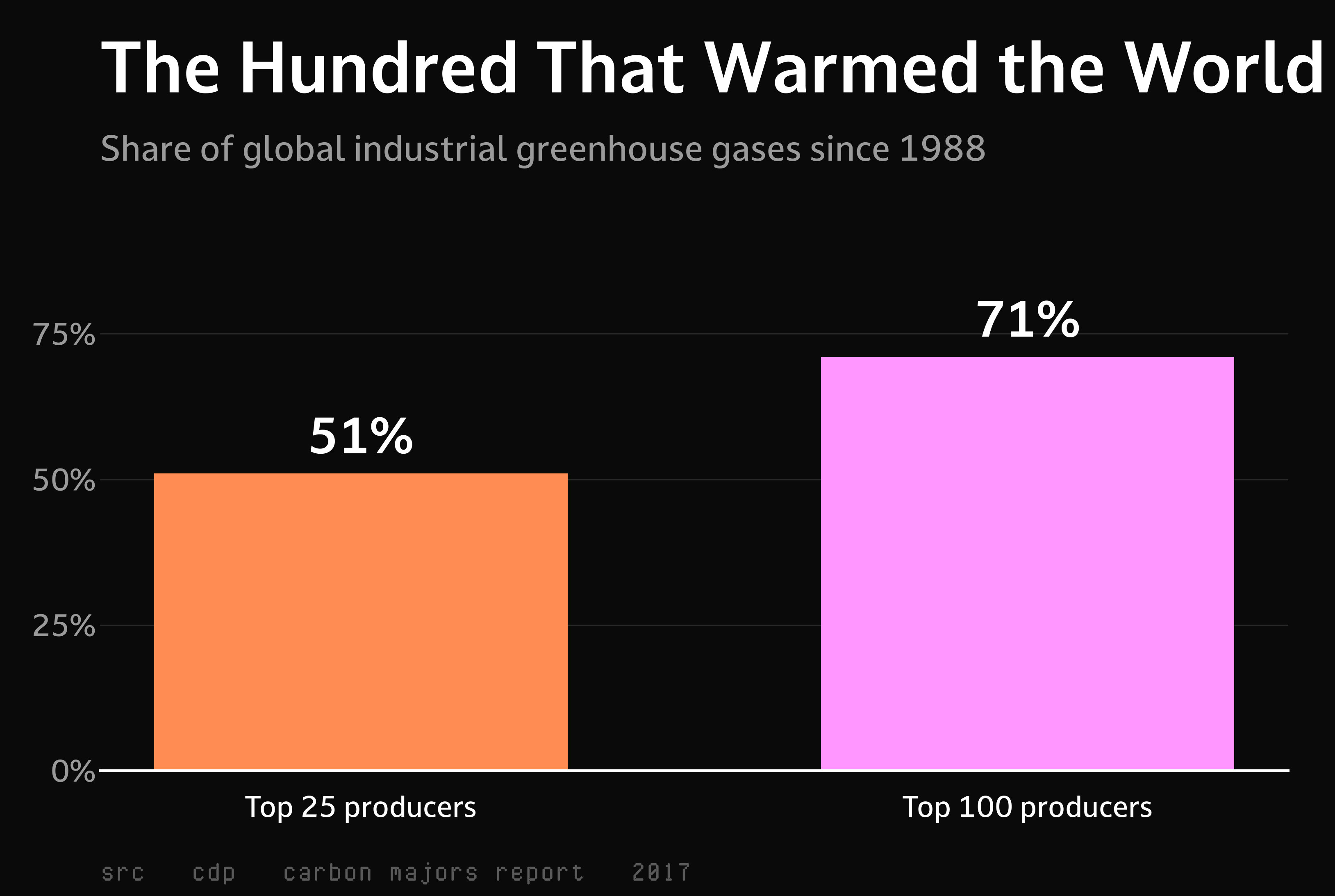
The arithmetic does not support the relocation. When the Carbon Disclosure Project traced the world’s industrial greenhouse gases to their sources, it found a hundred fossil-fuel producers behind roughly seventy-one percent of the total since 1988, and twenty-five behind more than half.
BP sat comfortably inside that group, among the largest investor-owned emitters in history, while about ninety-six cents of every dollar it invested went to finding and pumping more oil and gas. The four percent left over funded the solar panels in the advertisements. And the diet it was selling could not have worked in any case. A class at the Massachusetts Institute of Technology once worked out the footprint of a homeless American who owned nothing and drove nowhere, and still arrived at eight and a half tonnes a year, because the floor is the country itself, the roads and hospitals and supply chains everyone stands on whether they choose to or not. The climatologist Michael Mann calls this deflection. Keep people busy measuring their own footprints and they will not notice yours, nor demand the carbon prices and shut wells that actually move the numbers. It was the same move the packaging industry made in the 1970s, when a famous advertisement taught a generation that litter was a failure of personal character rather than a consequence of corporate output.
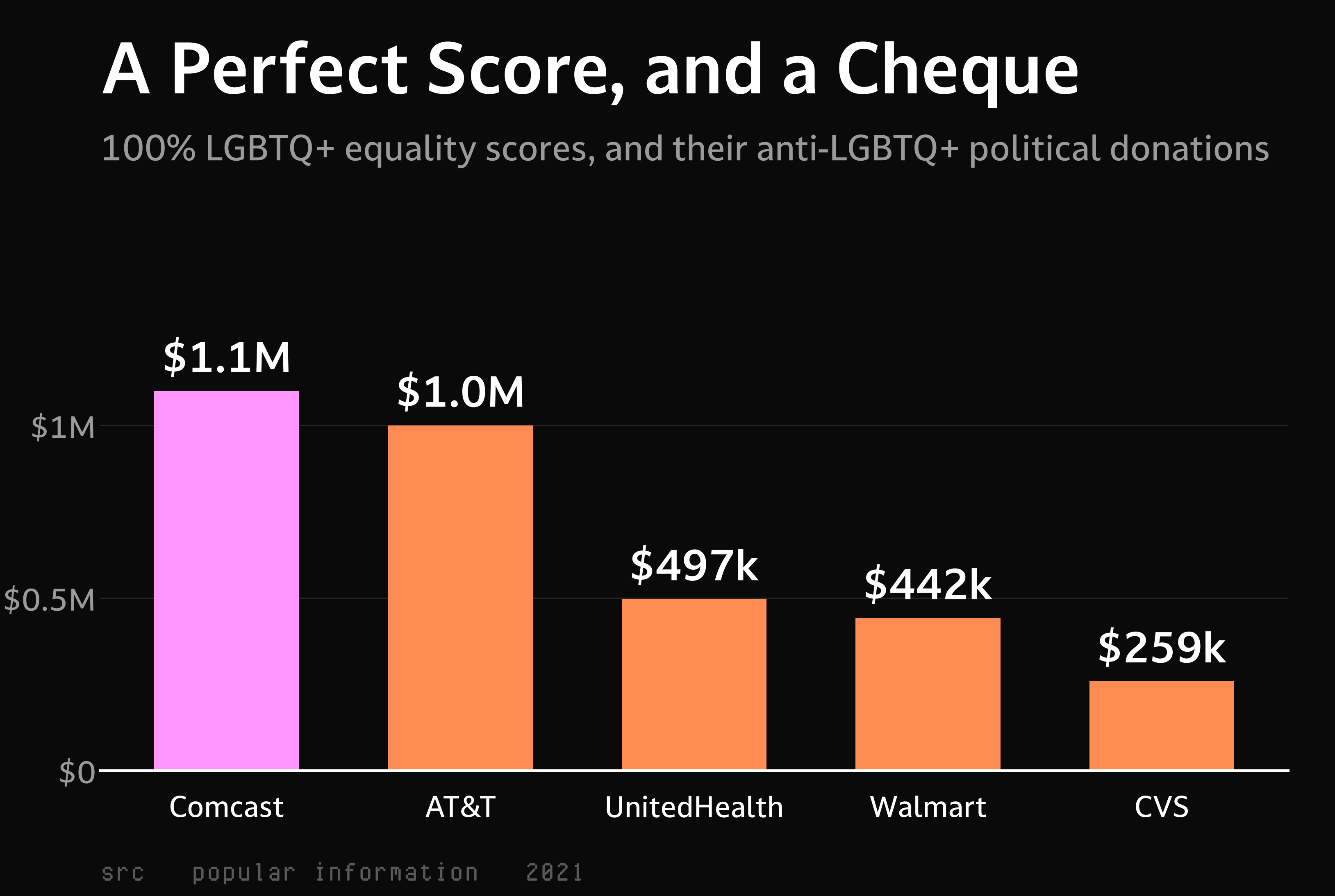
The oil company sold guilt. Others sell its cheerful opposite. Every June a familiar change passes over the corporate world. Logos bloom into rainbows, and brands that spend eleven months in grey announce that love is love. There is a market behind the display, the spending power of LGBTQ+ consumers runs into the trillions, and a rainbow is a cheap way to court it. The writer Judd Legum spent several years setting the branding beside the banking, and found that many of the same corporations posting Pride messages were, through their political action committees, funding the politicians writing laws against the people in the posts. The firms he tracked held near-perfect scores on the main corporate equality index, partly because that index does not count political donations. The logo stayed clean because the ledger was kept in another room.
Data
| Company | Anti-LGBTQ+ donations |
|---|---|
| Comcast | $1.1M |
| AT&T | $1.0M |
| UnitedHealth | $497k |
| Walmart | $442k |
| CVS | $259k |
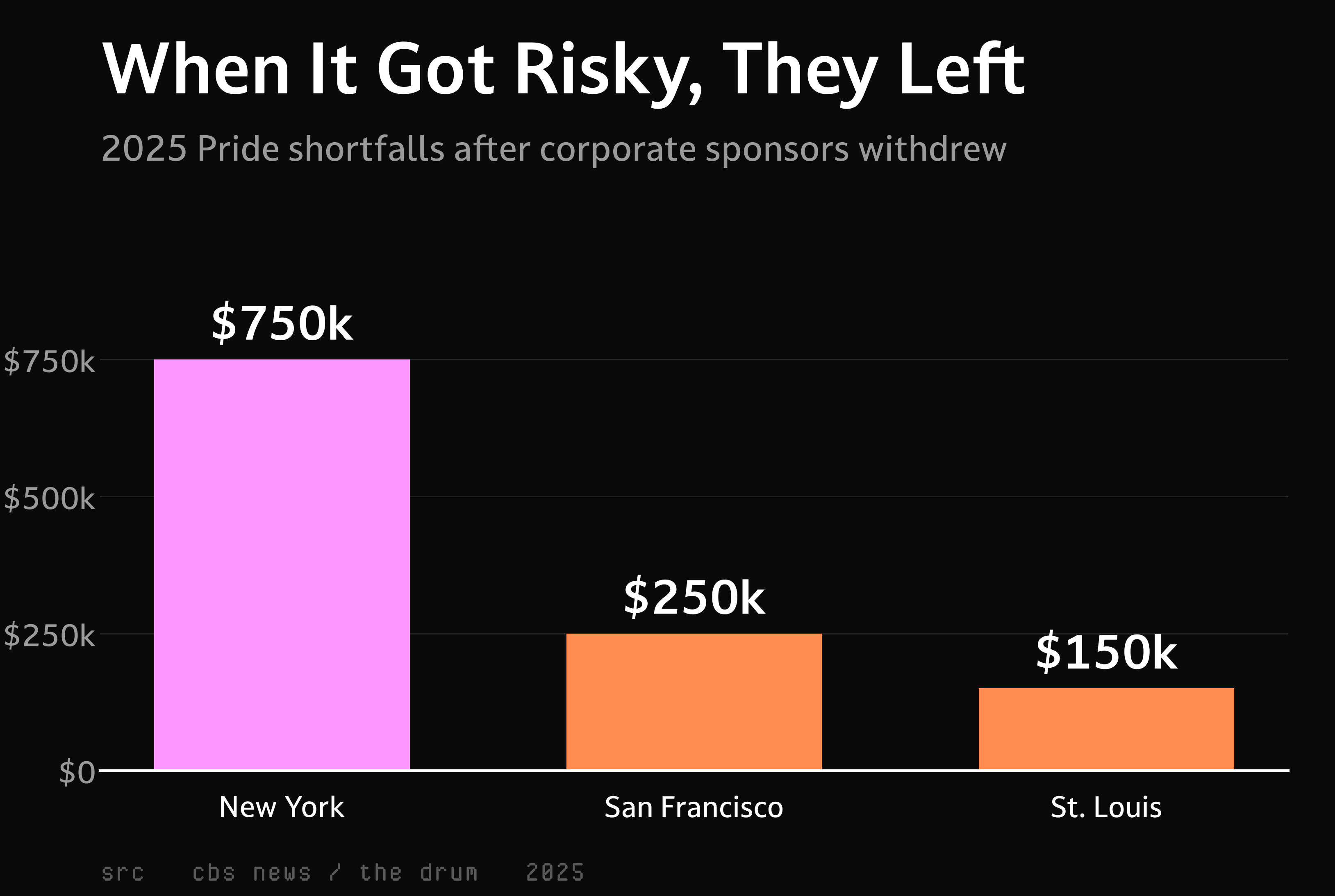
The geography gives the rest away. The rainbow appears on a company’s American and European accounts and disappears from its accounts in the Gulf, in Russia, in the markets where the sentiment would cost something. One carmaker, asked about the discrepancy, explained that Pride branding had to respect market-specific regulations and cultural aspects, which is a careful way of saying the value is real until it is expensive. And when the weather turned at home, after the boycotts of 2023 made Pride a political risk in the United States, the sponsors began to leave. Nearly two in five large brands planned to scale back for 2025, most citing fear of the new administration, and the retreat left holes where the money had been.
Support that vanishes the moment it carries a cost was never support. It was positioning, and positioning gets revised when the market moves. The public has largely worked this out. By 2024 a survey found nearly two-thirds of people already read corporate Pride as mostly performance.
Set the three beside each other and the family resemblance is hard to miss. The acknowledgement, the footprint calculator, the rainbow logo, each takes a real debt, moral or ecological or historical, and converts it into a feeling the individual can carry, share, or perform, while the institution keeps its money and its freedom of movement. It is virtue arranged as a marketing campaign, with a media plan and a seasonal schedule, and its product is not change but the sensation of it. The calculator asked you to account for yourself so BP would not have to. The rainbow asked for your applause so the donation could go out the back. My footer offered the dispossessed a mention so I would not have to sit with what a mention leaves undone.
I have not taken the footer down. I am not sure taking it down would be an improvement rather than a tidier way of changing nothing. Walker himself does not want the practice abolished. He wants it to lead somewhere, to open a conversation with the nation it names rather than close one. The words are not the problem. The problem is the hope, mine included, that a feeling might be enough, that if we are sorry enough, or careful enough, or colourful enough in June, the bill will not arrive.
I still think about the man on the sidewalk. I never learned what he was saying, and I have stopped pretending the footer was a reply. He was not asking to be named at the bottom of a web page. He was, in the only language that survived the distance between us, asking for something the page will never cost me enough to give.
Request an AI summary
Learn more about the ideas and references behind this note.
FAQ
- Did BP invent the carbon footprint?
- No. The footprint concept was built in the early 1990s by ecologists William Rees and Mathis Wackernagel at the University of British Columbia as the ecological footprint, a way to measure whole populations and economies. What BP did, through a roughly $200 million Beyond Petroleum campaign with the agency Ogilvy & Mather, was popularize the personal carbon footprint and a footprint calculator around 2004, shifting the frame from industrial production to individual consumption. BP appropriated and weaponized the idea; it did not invent it.
- What is the criticism of land acknowledgements?
- That they too often name a dispossession and, in the naming, absorb it, standing in for the funding, restitution, and policy change they gesture toward. A decade after the Truth and Reconciliation Commission's 94 Calls to Action, only about 13 are complete, and just 2 of the 231 Missing and Murdered Indigenous Women and Girls Calls for Justice are fully met. As the writer Reid Walker argues, the test is not the words but the action that follows them, and institutions tend to stop exactly where the cost would begin.
- What are some related topics to explore?
- virtue signalling as marketingland acknowledgement criticismcarbon footprint bp originrainbow washing corporate pridecarbon majors 100 companies emissionsperformative allyship reconciliation
Defined Terms
- Land acknowledgement
- A spoken or written statement recognizing the Indigenous nation whose traditional territory a place occupies, common in Canadian and US institutions.
- Rainbow washing
- The use of LGBTQ+ Pride imagery for marketing benefit without material support for, or while working against, LGBTQ+ rights.
Foundations
- The New Climate War
- Michael E. Mann, 2021
- Truth and Reconciliation Commission of Canada: Calls to Action
- Truth and Reconciliation Commission of Canada, 2015
Related Reading
Related Notes
- The Business of Belonging
- Every June, corporations discover queer rights. Rainbow logos flood feeds. July arrives and the rainbows vanish. The economics of annual visibility.
- The Work Survives the Maker
- Trotsky wrote one of the sharpest portraits of New York in 1917. Can valuable work come from a source you would otherwise reject?