
The Architecture of Modern Loneliness
How Public Space Quietly Stopped Holding Us Together
Loneliness is now a measurable public health emergency across continents. The 2025 WHO Commission on Social Connection attributes 871,000 deaths a year to social disconnection, roughly one hundred every hour, with one in six people worldwide affected. The UK Office for National Statistics records 23 percent of British adults as lonely some or most of the time. A 2024 Bertelsmann study found 57 percent of Europeans aged 18 to 35 moderately or severely lonely, with France at 63 percent. Japan's Cabinet Office records 4.5 percent of citizens as often or constantly lonely, rising to 17.3 percent among those who seldom share a meal with anyone else. The cause is not screens. It is the disappearance of the third place, the unstructured rooms and neighbourhoods where strangers used to coexist. The replacement environments do not require the muscle for low-stakes coexistence, and gradually atrophy it.
Somebody orders a flat white, opens a laptop, puts on headphones, and disappears. The room is full of people doing exactly this, and the building they are in used to be something else.
For several centuries, across continents and political climates, the coffeehouse was where news travelled before newspapers could, where workers organised before unions had offices, where dissidents gathered because the cost of entry was low and the expectation of lingering was built in. The Indian Coffee House in Connaught Place, New Delhi, was one of the most consequential examples in the twentieth century. Worker-owned cooperative, opened in 1936, by the 1960s and 1970s a daily political crossroads where Communists, Socialists, Naxalites, Congress regulars, and the Hindu nationalist RSS each had their own table. During the Emergency declared by Indira Gandhi in 1975, on the morning of 15 May 1976, demolition crews arrived without notice and razed the building. The regime understood the architecture better than most architects do. The conversations were not incidental to the room. They were the function of it.
The sociologist Ray Oldenburg gave that arrangement a name in 1989. He called it the “third place,” the location outside home and work where unstructured social life happens. Bars, barbershops, post offices, libraries, public squares. Robert Putnam, writing a decade later in “Bowling Alone,” documented what had happened to those places in the late twentieth century. Civic associations, bowling leagues, church groups, parent-teacher meetings, every measure of associational life trending downward, year over year, with a steepness that surprised researchers when it was first plotted.
The numbers have not improved, and they are no longer only American. The United States Surgeon General issued a public health advisory in May 2023 titled “Our Epidemic of Loneliness and Isolation,” linking chronic loneliness to a mortality risk comparable to smoking up to fifteen cigarettes a day, with a separate finding of a roughly 30 percent increase in the risk of premature death from social disconnection. Two years later the World Health Organization’s Commission on Social Connection put a figure on the global tally in its Global Roadmap for Action, attributing 871,000 deaths a year to social disconnection, roughly one hundred every hour, with one in six people worldwide affected, and called for connection to be treated as a public health priority.
The picture outside the United States is similar in shape, different in texture. The UK Office for National Statistics reported in January 2026 that 23 percent of British adults felt lonely often, always, or some of the time, with the highest rates among 16 to 29 year olds at 27 percent. A 2024 Bertelsmann Stiftung study of more than 23,000 respondents across the EU found that 57 percent of Europeans aged 18 to 35 were moderately or severely lonely, with France reaching 63 percent. Japan’s Cabinet Office, in its April 2026 release of survey data, recorded 4.5 percent of citizens as often or constantly lonely, a figure that rose sharply, to 17.3 percent, among those who seldom share a meal with anyone else. The same ministry was created in 2021 to address the rise of kodokushi, the lonely deaths now appearing in social-service caseloads.
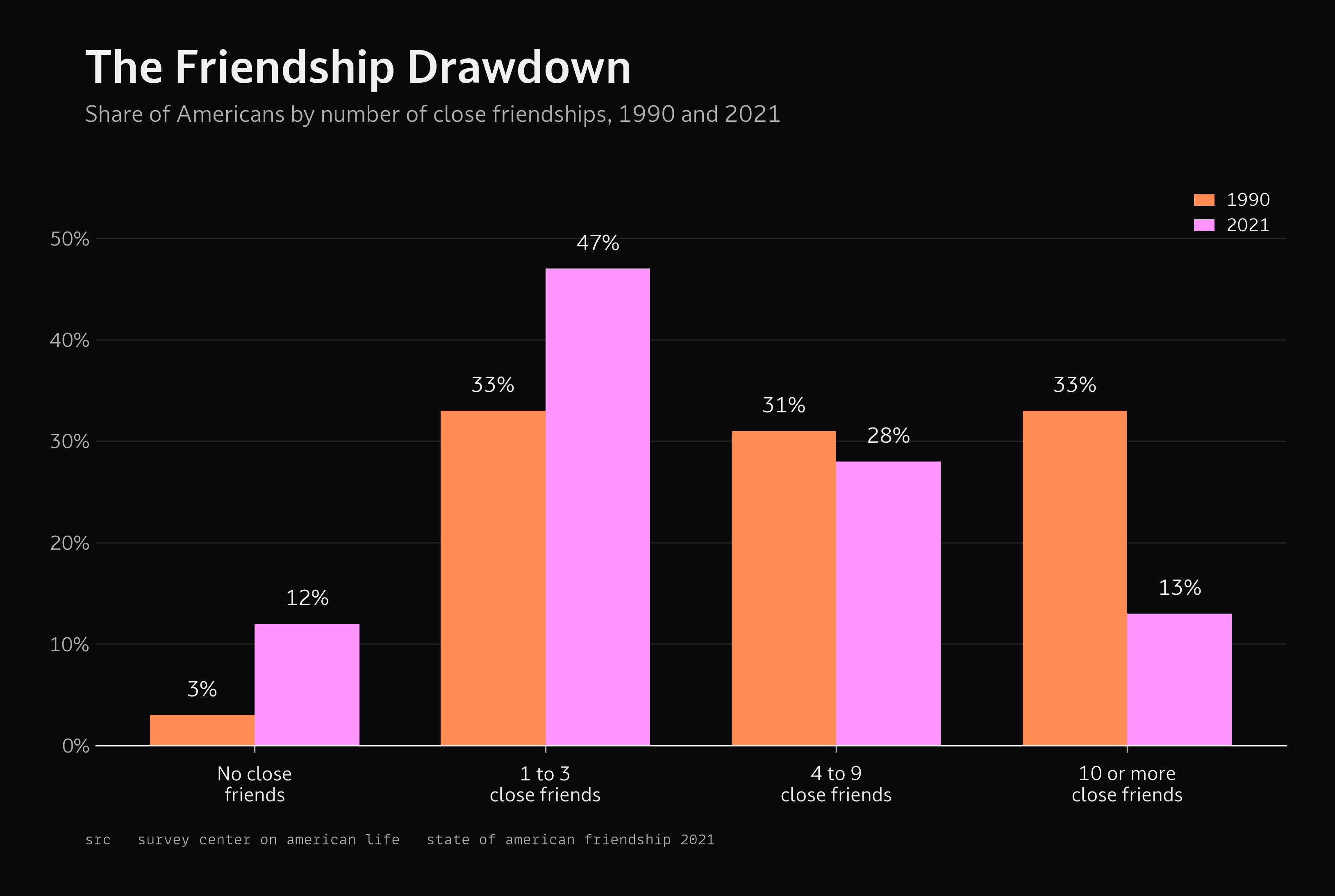
The American measurements add granularity to the same trend. A January 2024 American Psychiatric Association poll found nearly one in three American adults lonely at least once a week, with 30 percent of those aged 18 to 34 reporting loneliness every day or several times weekly. Harvard’s Making Caring Common project, in its 2024 “Loneliness in America” survey, recorded that 21 percent of US adults felt actively lonely, with 81 percent of that group reporting concurrent anxiety or depression. The Survey Center on American Life found that the share of Americans reporting no close friends rose from 3 percent in 1990 to 12 percent by 2021, with men accounting for most of the increase.
Data
| Close friends | 1990 | 2021 |
|---|---|---|
| None | 3% | 12% |
| 1 to 3 | 33% | 47% |
| 4 to 9 | 31% | 28% |
| 10 or more | 33% | 13% |
These are not symmetrical changes. The loss of associational life did not produce a quieter, more contemplative population. It produced people who feel surrounded and unaccompanied at the same time.
Strangers still talk to each other in public, but the vocabulary has narrowed. The weather is the safest available subject. Two people waiting at a bus stop will mention the cold, the rain, the surprising mildness of November, and arrive at nothing further. The conversation is real, in the sense that words are exchanged, but it is a kind of phatic communication, language used to confirm the social channel rather than to transmit content. Linguists distinguish that function from referential speech, which actually carries information. When the only available register is phatic, the channel stays open but nothing moves through it.
This is not a problem unless something needed to move through. A society held together by repeated, low-stakes contact among strangers is one in which the eventual high-stakes contact has somewhere to land. Without the small exchanges, the large ones have no precedent. People who have never agreed on the weather will not find it easier to disagree on anything else.
The exception to the narrowed register is the liminal space, the location understood by everyone in it to be temporary. Airport lounges, overnight train cars, hospital waiting rooms, the laundromat at two in the morning. Strangers in these places speak with a frankness that would be considered intrusive anywhere else. The social psychologist Zick Rubin documented this in a 1975 paper drawn from work in airport departure lounges and bus terminals, and the pattern has been called the “stranger on a train” effect ever since. The conditions that produce it are specific. The other person is verified non-permanent, the encounter has a known endpoint, and the social cost of any revelation is bounded by the certainty that you will not meet again.
What this reveals is that the appetite for honest conversation has not disappeared. It has been displaced. People will talk, fully and at length, when the architecture of the room permits it. The architecture of most rooms now does not.
Online platforms were supposed to absorb the social function of the third place, and in narrow ways they did. Movements still organise, petitions still circulate, the people who would have met in a coffee house find each other in a thread. But the texture of a shared room turns out to be load-bearing in ways the substitute does not replicate. The offhand conversation, the accidental contact with someone whose politics irritate you, the slow accumulation of trust that comes from repeated proximity, that is harder to deliver asynchronously.
The architecture of online platforms also rewards a specific kind of engagement. Posts that generate response, content that polarises, the indicators that produce algorithmic surfacing. The system optimises for engagement, which is not the same as connection. The Surgeon General’s report cited research finding that adults who used social media for two or more hours a day were roughly twice as likely to report feeling socially isolated as those who used it for less than thirty minutes. The connection produces isolation, which is the specific paradox these platforms have not figured out how to resolve.
Sociologists studying weak-tie networks have a longer-standing finding that bears on this. Mark Granovetter’s 1973 paper, “The Strength of Weak Ties,” argued that the casual acquaintances most people maintain, the people they nod to but do not call, are the ones who carry novel information across social boundaries. Job leads, political ideas, restaurant recommendations, the dispersal of usable knowledge through a population depends on weak ties. The decline of third places is, among other things, a decline in the infrastructure that produces weak ties. Without them, information clusters and ages, circulating only inside the tight networks that already shared it.
The vocabulary that did emerge online to fill the channel has problems of its own. The shorthand laughter that ends most informal messages was coined to indicate a specific physiological event, the audible expression of amusement. It is now used to soften a statement, to indicate mild appreciation, to fill the end of a message that would otherwise feel too blunt. Its relationship to actual laughter is approximately what a picture of fire has to actual warmth. The signal still appears, regularly, but it has stopped carrying information.
This is signal inflation. When every message is decorated with indicators of warmth and amusement, the indicators stop functioning as indicators. The message where the small acknowledgment is absent now reads as cold, which was not the original encoding. The vocabulary of connection has been performed so consistently that the absence of performance reads as hostility, and the presence of performance reads as nothing in particular.
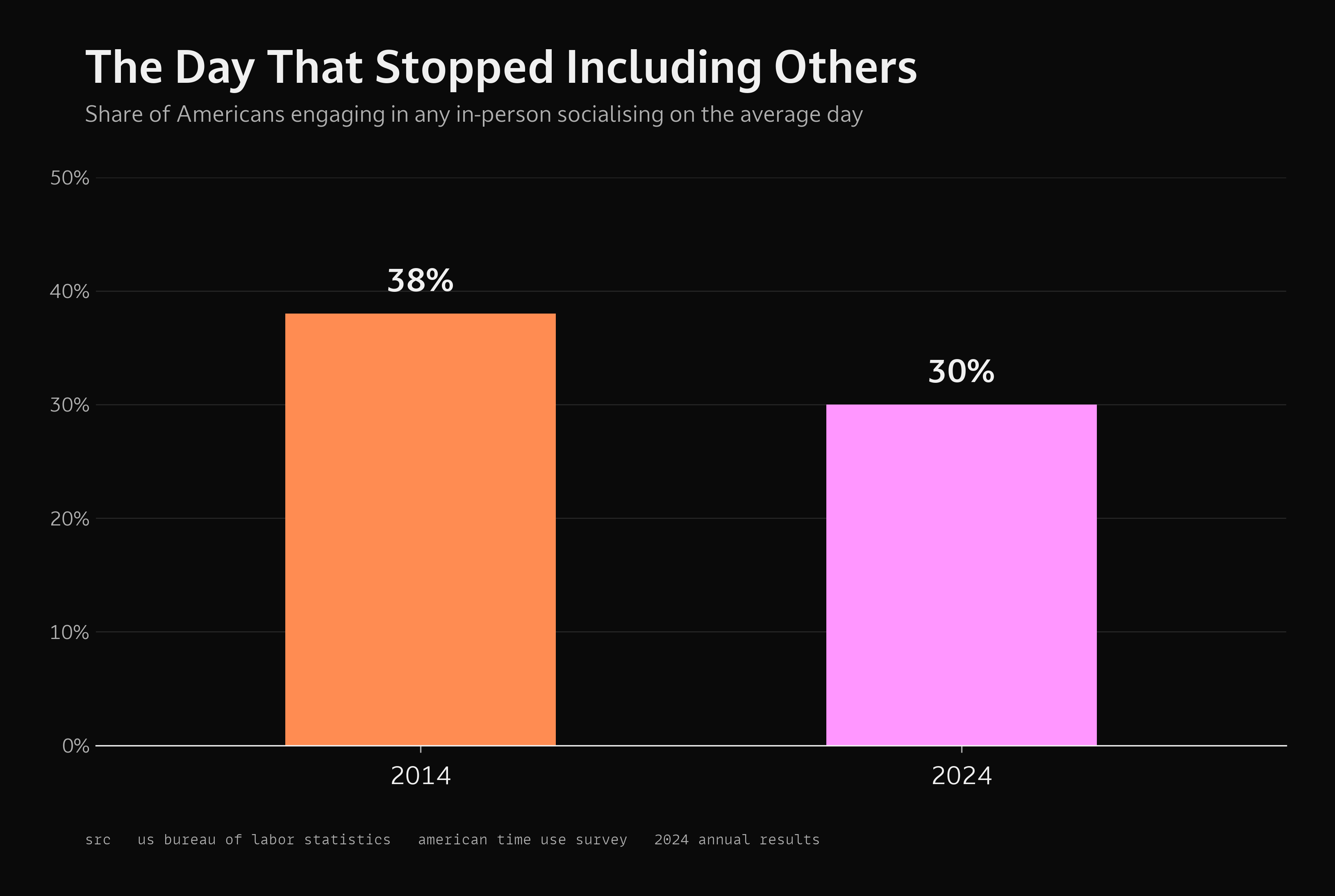
The American Time Use Survey, run by the Bureau of Labor Statistics every year since 2003, gives the clearest behavioural picture. In its 2024 release, the BLS noted that only 30 percent of Americans engaged in any in-person socialising or communicating on the average day, down from 38 percent in 2014. The average duration also shrank, settling at roughly thirty-five minutes a day, with weekend days carrying more than double the weekday total. The hours did not disappear. They were absorbed by screens, which is well-documented, and by solitary leisure, which is documented less often. The 2025 Cigna Loneliness in America report extended the picture into the workplace, finding that 52 percent of American workers now meet the threshold for loneliness, with Gen Z reporting the highest cohort rate at 67 percent.
Cécile Van de Velde, sociologist at the Université de Montréal, frames modern loneliness in her 2025 introduction to the field as a structural phenomenon rather than a private one, revealing the fault lines of contemporary society. Where people see no possibility of collective action, she argues, the tail end of isolation runs into political radicalisation, with incels offered as one familiar case. A March 2026 University of Canberra report names the architectural side of the same problem, recording that 43 percent of young Australian adults reported feeling lonely in recent surveys and quoting participants who described well-resourced suburbs as feeling socially “hollow.” Its central recommendation is to reframe social connection as a public good rather than loneliness as a personal failing. The shape of the building still matters. The shape of the neighbourhood, the shape of the labour market, the shape of who can afford to linger and where, all matter together.
What gets harder to recover under these conditions is calibration. The third place was not therapeutic. It was not always pleasant. It contained people who irritated you, opinions that bored you, conversations that went on too long. What it produced was not joy or fulfilment but practice. Practice in disagreeing without leaving. Practice in being slightly bored among other humans. Practice in the recognition that being among people and being with them are different verbs that gradually convert into one another through repetition.
The replacement environments do not require practice. They permit the convenience of leaving whenever the room becomes briefly uncomfortable, which most rooms eventually do. The result is a population that has lost the muscle for low-stakes coexistence, and a public health advisory that names the consequence without quite explaining how the muscle was lost.
Whether that matters depends on what you think collective life actually requires. Some things move fast without it. Others, apparently, do not move at all.
Request an AI summary
Learn more about the ideas and references behind this note.
FAQ
- How serious is the loneliness epidemic globally in 2026?
- Serious enough to register as a public health emergency across continents and authoritative bodies. The WHO Commission on Social Connection's 2025 Global Roadmap for Action attributes 871,000 deaths a year worldwide to social disconnection, roughly one hundred every hour, with one in six people affected, and asks governments to treat connection as a public health priority. The UK Office for National Statistics records 23 percent of British adults as lonely some or most of the time. A 2024 Bertelsmann Stiftung study found 57 percent of Europeans aged 18 to 35 were moderately or severely lonely. Japan's Cabinet Office records 4.5 percent of citizens as often or constantly lonely, rising to 17.3 percent among those who seldom eat with anyone else. In the United States, the 2023 Surgeon General advisory placed the mortality risk of chronic loneliness alongside smoking up to fifteen cigarettes a day.
- Why have online platforms not replaced in-person social contact?
- They reproduce some functions of the third place, like organising and circulation, but not the texture. Offhand conversation, accidental contact with people whose politics irritate you, and the slow accumulation of trust through repeated proximity all require shared physical space, and asynchronous platforms cannot deliver them. Algorithmic feeds also optimise for engagement, which is not the same as connection. The US Surgeon General has linked heavy social media use to elevated loneliness scores even after controlling for offline social activity, and the 2024 Bureau of Labor Statistics time-use survey shows in-person socialising participation dropped from 38 percent to 30 percent of adults between 2014 and 2024.
- What are some related topics to explore?
- loneliness epidemic 2026third place declineWHO commission on social connectioncost of living isolationkodokushi lonely deathssocial connection policyphatic communicationweak ties theory
Defined Terms
- Third place
- Ray Oldenburg's term for the location outside home and work where unstructured social life happens, defined by low cost of entry, regulars, neutral ground, and a built-in expectation of lingering.
- Phatic communication
- Speech whose social function is to confirm the channel rather than to transmit content. The exchanged comment about the weather, the small acknowledgment that keeps the line open without saying anything in particular.
Foundations
- The Great Good Place
- Ray Oldenburg, 1989
- From Loneliness to Social Connection: A Global Roadmap for Action
- WHO Commission on Social Connection, 2025
Related Reading
Related Notes
- The Friendship We Outgrew
- Scrolling past friends creates an illusion of closeness while masking growing distance. Why modern friendships end in silence instead of a fight.
- The Economics of Exhaustion
- The alarm goes off at a number the body never agreed to, and we call the result a personal failing. Social jetlag, the daily gap between biological time and the schedule imposed on it, is near universal and quietly expensive. Some economies lose almost three percent of GDP to being tired.
- The Burger That Benchmarks Everything
- A monthly design subscription costs the same in San Francisco as in Sarajevo, but the dollar does not. A famous sandwich index was built to measure that gap, and regional software pricing quietly tried to answer it, until users acted on the logic and the companies pulled it back.