

Référendum Québec
Référendum Québec is a neutral guide to Quebec's 1980 and 1995 referendums, in French and English. It covers where the question comes from, what the sovereignty movement wants, the case for and against, other separations around the world and the practical questions a Yes would raise. Every fact names its source.
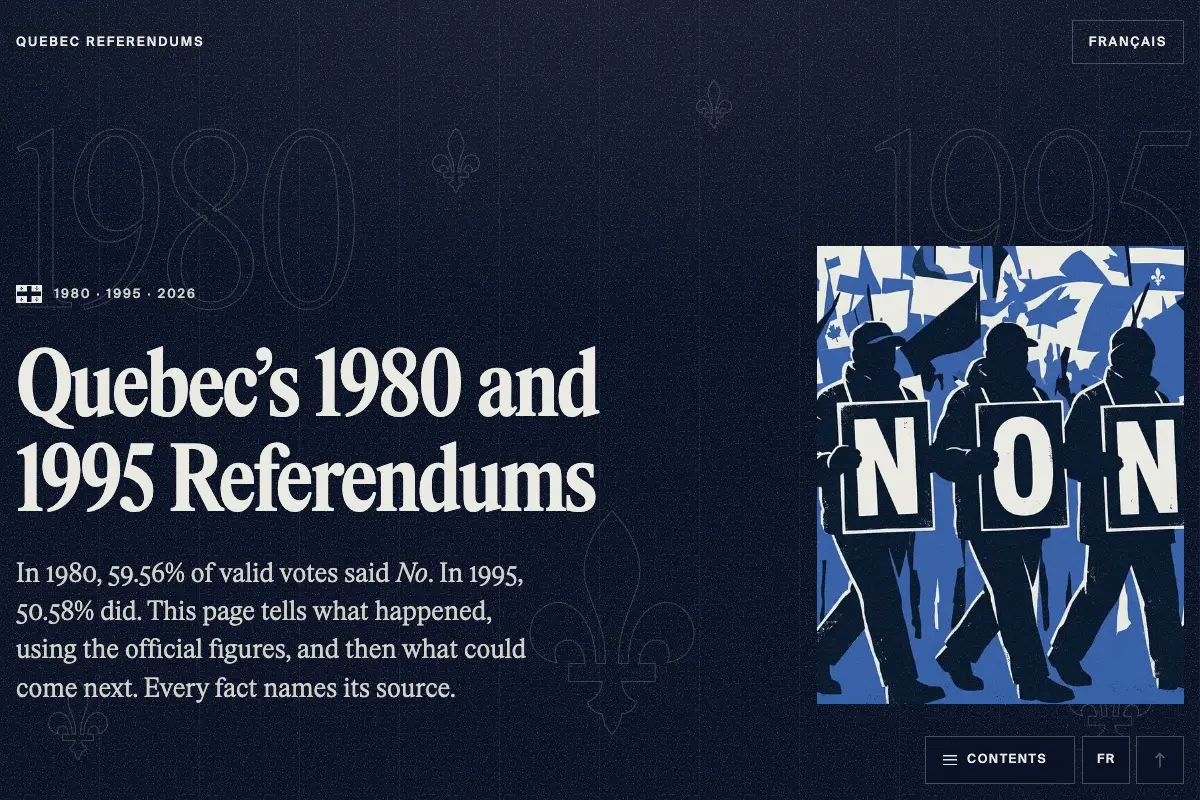
What problem does it solve?
Quebec has voted twice on sovereignty, and the question keeps coming back. Most explainers either take a side or bury readers in legal wording. This one tells the story plainly, in both languages, and shows where every fact comes from.
How it works
One long page, French first, with a full English version. It opens with the essentials and the key words, then walks through where the question comes from, the 1980 and 1995 votes, what the movement wants and the case for and against. A chapter on other separations sets Quebec beside Scotland, Catalonia, Brexit and others, and a grid of practical questions covers currency, passports and debt, attributed and never forecast. A contents drawer stays in the corner, and the annex holds the glossary and sources.
Whom it’s for
Newcomers to Quebec, Quebecers who lived through the votes or were born after them, and journalists or visitors who want the facts without the campaign.
Tech
Astro, with GSAP for the reveals and parallax. Illustrations were made from archival references. Hosted on Vercel.
Frequently asked questions
Does the site take a side?
No. It is not affiliated with any party, campaign or government. Contested claims are attributed to whoever makes them.
Which languages is it in?
French first, with a full English version at /en.
Where do the numbers come from?
Official results and published sources. Every fact links to its source, and the annex lists them by document type.
Does it compare Quebec with other places?
Yes. A chapter looks at Norway and Sweden, Czechoslovakia, Montenegro, Scotland, Brexit and Catalonia.
How long does it take to read?
About fifteen minutes. It is written to be scanned, with the depth kept in the sources and the glossary.