
Marie Curious
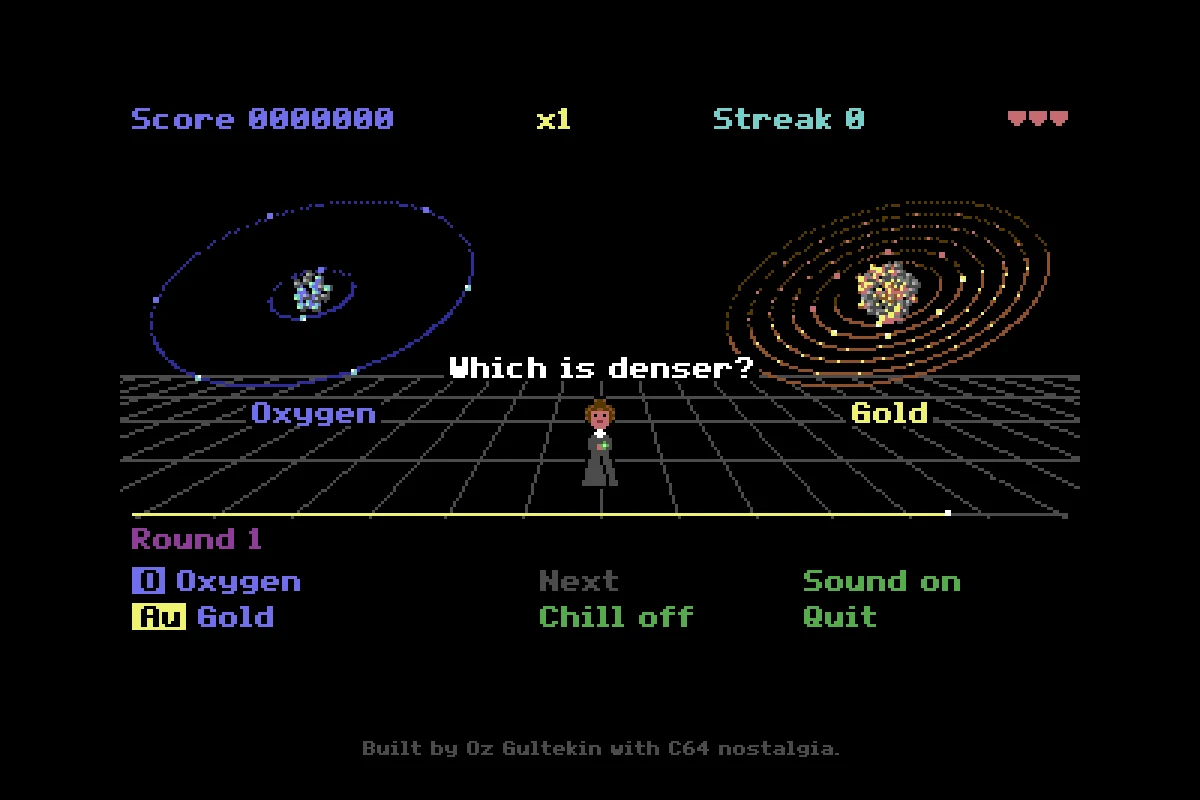
Marie Curious is a chemistry quiz drawn like a Commodore 64 game. Each round Marie floats two elements in front of you and asks one thing, such as which is heavier, denser or hotter to melt. Pick before the fuse burns out and she shows you the real numbers. Right answers in a row build a combo, three misses end the run, and the best scores go on a high score table next to some famous chemists.
What problem does it solve?
Most people meet the elements as a chart to memorize. Marie Curious turns them into a quick question you can answer on a hunch. Is gold heavier than lead? Does mercury melt colder than bromine? You guess, Marie shows you the numbers, and they stick a little better each round.
How it works
Each round two atoms float over Marie’s grid and she asks one thing. Tap the atom or the name of the one you think wins before the fuse burns out. Both real values appear once you pick, so a wrong guess still teaches you something. The first rounds use elements most people have heard of, with answers far apart, and the pairs get closer as you go.
Right answers in a row build a combo up to five times the points, and faster answers score more. Three misses end the run with a rank, from Goggles on to Nobel material. A score good enough for the table asks for your initials, arcade style. Chill mode turns the fuse off.
The game opens on a blue start screen that types itself out, and the whole picture keeps to the sixteen colours a Commodore 64 could show.
Whom it’s for
Anyone who grew up on 8-bit games, students who want a lighter way into the periodic table, and the curious who never knew tungsten melts at 3,422 °C.
Tech
Plain JavaScript and a single canvas, with no framework. Every frame is drawn at a low resolution and snapped to the Commodore 64’s palette. The atoms are drawn from each element’s real data, one ball per proton and neutron and the true number of electrons on each shell. Element facts come from Periodic Table JSON. High scores stay in your own browser.
Frequently asked questions
What is Marie Curious?
A chemistry quiz game in the style of a Commodore 64 adventure. Marie shows you two elements and asks which one wins on a single property.
Do I need to know chemistry?
No. The opening rounds use elements most people have heard of, with answers far apart. Every round shows the real values, so you learn as you play.
What does Marie ask about?
Which element is heavier or lighter, which is denser, which melts hotter or colder, which boils hotter and which pulls harder on electrons. After you pick, both real values appear over the atoms.
Who is on the high score table?
Five chemists hold the table until you beat them. They are Marie Skłodowska-Curie, Pierre Curie, Dmitri Mendeleev, Rosalind Franklin and Antoine Lavoisier. Beat one and you sign your initials above them.
Can I play without the timer?
Yes. Chill mode turns the fuse off and waits for you to move on. With it off, the next round starts on its own a moment after each answer.
Does it work on a phone?
Yes. It was laid out for phones and tablets first, and it switches to a classic wide screen on larger displays. It also plays with the keyboard alone, using the arrow keys and Enter.
Is it free?
Yes. It runs in the browser with nothing to install. High scores stay in your own browser.